Last updated 2026-07-25
TL;DR
Unopened, lyophilized PT-141 stays stable refrigerated (roughly 2 to 8°C) for the manufacturer's labeled dating; once mixed with water it should be refrigerated and used within about 2 to 4 weeks per most compounding pharmacy guidance. Freezing, heat, and light all degrade the peptide faster. The FDA-approved product, Vyleesi, comes as a single-use prefilled autoinjector meant for one dose, not storage after opening.
How should PT-141 be stored before it's mixed?
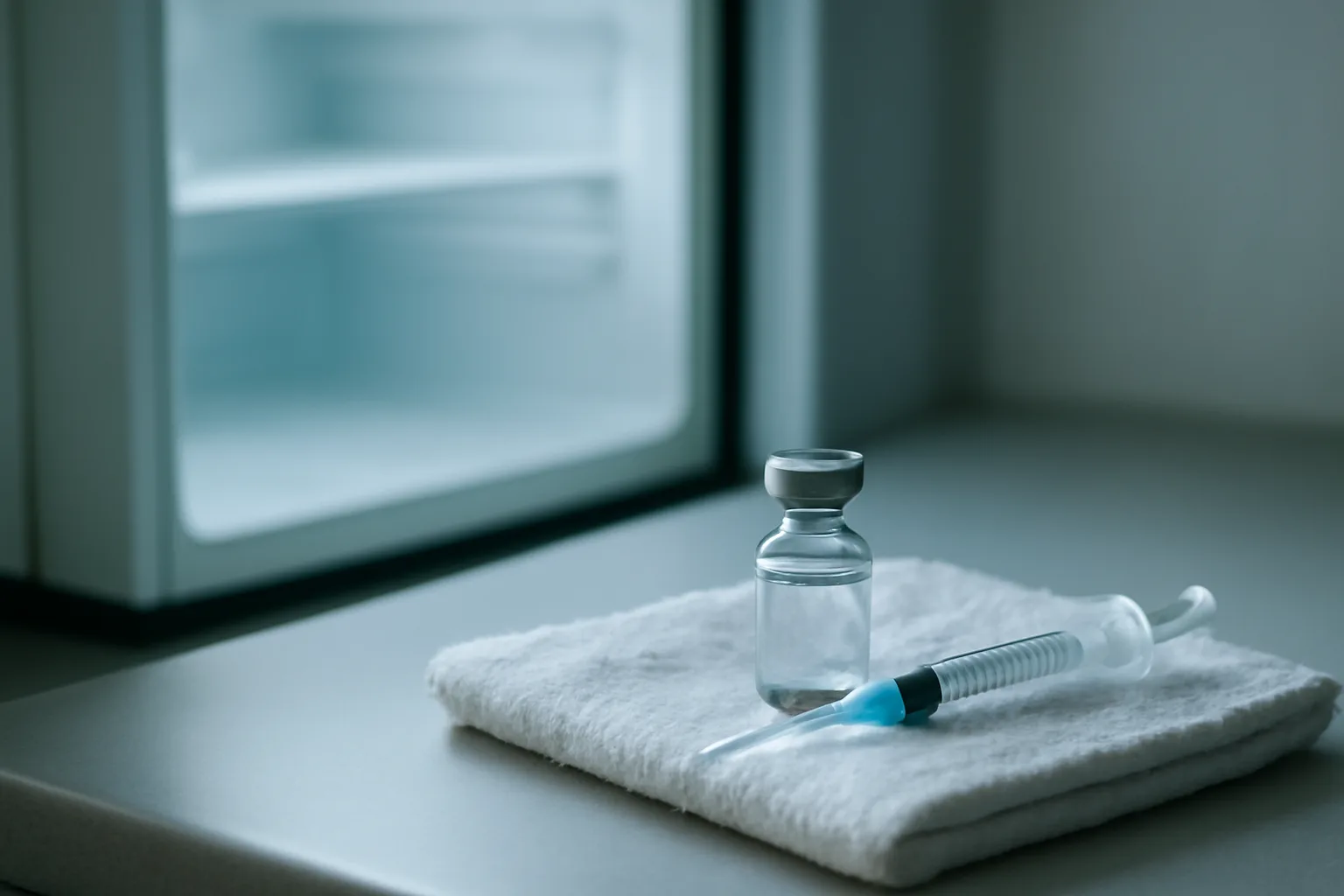
Unreconstituted (lyophilized, freeze-dried) PT-141 is a powder in a small vial, and it's the most stable form of the peptide. Store it in a refrigerator, generally in the 2 to 8°C range (36 to 46°F), away from light. Some compounding references also allow freezer storage for the unmixed powder over longer periods, but refrigeration is the standard advice you'll see on compounding pharmacy handling sheets. Don't leave the vial on a counter, in a car, or anywhere that gets warm. Peptides are chains of amino acids held together by specific bonds, and heat accelerates the breakdown of those bonds. Bremelanotide itself is a cyclic peptide derived from a fragment of alpha-melanocyte-stimulating hormone [1], and like most peptides it's more fragile than a small-molecule tablet sitting in your medicine cabinet. Light matters too. Keep the vial in its original box or an opaque container. This isn't specific to PT-141, it's just standard peptide handling practice used across compounding pharmacies. If you're getting bremelanotide through the FDA-approved route, the product is Vyleesi, a single-use prefilled autoinjector [2]. There's no mixing step and no vial to store in your fridge for weeks, because each pen is one dose, used once, then discarded.
How long does reconstituted PT-141 last in the fridge?
Once sterile water is added to the powder, the clock starts. Most compounding pharmacy guidance for reconstituted peptides like PT-141 puts refrigerated stability at roughly 2 to 4 weeks, stored at 2 to 8°C. Some pharmacies claim longer, some shorter. There isn't a large published stability study specific to reconstituted bremelanotide solution that sets a precise, universally agreed number, so treat the 2 to 4 week window as a practical, conservative guideline rather than a hard scientific constant. This is different from the FDA-approved autoinjector, which is manufactured, filled, and sealed under pharmaceutical conditions with a labeled expiration date on the box. That dating is established through formal stability testing as part of FDA approval [2], which is a different level of assurance than a home-mixed vial. A few practical points if you do have a reconstituted vial: - Label the vial with the date you mixed it. It's easy to lose track after two weeks.
- Keep it refrigerated the entire time, more than "most of the time."
- Don't leave it out at room temperature for extended stretches between doses.
- If you're unsure how long it's been sitting, the safer move is to not use it.
Can you freeze PT-141, mixed or unmixed?
Unmixed, lyophilized powder can often tolerate freezer storage, and some compounding pharmacies recommend it for long-term stock. Once reconstituted, freezing is generally discouraged. Repeated freeze-thaw cycles can physically stress a peptide solution (ice crystal formation, aggregation at the molecular level), and there's no solid published data specific to bremelanotide showing that freeze-thawed solution retains full potency. The practical rule: freeze the powder if you must store long term, refrigerate (don't freeze) once it's mixed, and never refreeze a solution that's already been thawed.
What temperature actually damages PT-141?
Heat is the main enemy. Leaving a vial in a hot car, near a stove, or in direct sun for hours is the kind of exposure that degrades peptide structure. There's no published bremelanotide-specific heat-degradation curve that gives you an exact "it's ruined after X hours at Y degrees" number, so the honest answer is: nobody has published that precise threshold for this specific peptide. The safe assumption used across peptide handling guidance is to treat brief accidental warming (a couple hours, moderate room temperature) as probably fine, and sustained heat exposure (a hot car, a heating vent) as a reason to discard the vial. Light exposure and repeated vial punctures (introducing air and potential contamination each time) also shorten usable life, which is part of why single-use delivery systems like the Vyleesi autoinjector [2] sidestep the whole problem. One needle, one dose, no repeated access.
| Storage scenario | Typical guidance | Confidence |
|---|---|---|
| Unopened lyophilized powder, refrigerated | Stable per manufacturer/compounder dating | Standard peptide handling practice |
| Unopened lyophilized powder, frozen | Often acceptable for long-term storage | Compounding pharmacy guidance, not a specific published trial |
| Reconstituted solution, refrigerated | About 2 to 4 weeks | Practical compounding guidance, not a fixed published number |
| Reconstituted solution, frozen or freeze-thawed | Not recommended | No solid stability data supporting this |
| Vyleesi autoinjector, unopened | Labeled expiration on packaging | FDA-approved product [2] |
How do you know if PT-141 has gone bad?
Look at the solution. Cloudiness, visible particles, or a color change from clear (or very faintly straw-colored) to something noticeably darker or discolored are signs to stop and discard. A peptide solution that looks different than it did on day one has likely started to break down. Effectiveness fading is a subtler sign and harder to pin down, because HSDD symptom response varies person to person even with fresh drug. In the phase 3 RECONNECT trials, on-demand subcutaneous bremelanotide produced statistically significant improvement in desire and reduction in distress compared to placebo, but the effect size was modest, and not every participant responded [3]. So if a vial that's a few weeks old "isn't working," that could be degradation, or it could just be normal variability in response. When in doubt, don't guess, replace the vial. If you want to understand what a typical working dose looks like and how response is tracked, see PT-141 dosage.
Does an expired PT-141 vial become dangerous, or just less effective?
The bigger practical risk with an old or improperly stored vial isn't toxicity, it's that you inject something that no longer contains the labeled dose, or that's been contaminated from repeated needle access into a multi-dose vial over weeks. Degraded peptide is more likely to just do less (or nothing) than to cause a new form of harm, but a contaminated injection is a real infection risk regardless of what's degraded chemically. This is a good moment to mention that self-mixed vials sourced outside the FDA-approved supply chain carry a different risk profile than a manufactured, single-use autoinjector. Bremelanotide is approved by the FDA only as Vyleesi, delivered by prefilled autoinjector for on-demand subcutaneous use in premenopausal women with acquired, generalized hypoactive sexual desire disorder [2][4]. Bulk bremelanotide powder sold for reconstitution falls into a separate, less regulated category, and the bulk substance appears on FDA's nominated bulk drug substances list under section 503A compounding review , not as an approved finished drug itself. For readers who want the provider-reviewed route rather than home reconstitution, Bremelanotide Rx focuses on connecting people with that path, working with a licensed pharmacy partner rather than shipping a bulk powder vial for you to mix yourself.
How is PT-141's storage different because of how it works in the body?
This matters more than it sounds like it should. PT-141 doesn't work like sildenafil or other PDE5 inhibitors, which act on blood vessels to increase blood flow. Bremelanotide is a melanocortin receptor agonist that acts centrally, in the brain, primarily through MC4R pathways involved in sexual motivation [5]. That central mechanism means the drug has to reach systemic circulation intact and cross into the relevant neural signaling pathways to work at all. A peptide that's partially degraded from poor storage doesn't just work "a little less well" in a predictable way the way a slightly-degraded vasodilator might; it may simply fail to trigger the central signaling cascade at an effective level, since bremelanotide is documented to have low oral bioavailability and depends on subcutaneous delivery to reach effective plasma levels . Since the entire therapeutic mechanism depends on an intact peptide reaching central melanocortin receptors, storage quality is not a minor issue here, it's the difference between a functioning dose and an inert injection. For a full breakdown of who shouldn't use bremelanotide regardless of storage quality (uncontrolled hypertension and certain cardiovascular conditions are relevant here), see PT-141 contraindications.
Do side effects change if the peptide has degraded?
Nausea and flushing are the two most common side effects reported across bremelanotide's clinical trial program, and they're dose-related, tied to melanocortin receptor activation, not to storage problems. In pooled phase 3 safety data, nausea was the most frequently reported adverse event among women taking bremelanotide, with flushing also common [6][3]. There's no published evidence that a degraded, less potent vial causes worse side effects. If anything, a weaker or partially broken-down dose would be expected to produce less drug effect, including fewer side effects, not more. What degradation more plausibly causes is simply a lower chance the dose does what you wanted it to do. If nausea or flushing is severe, that's a reason to talk to the prescribing provider about dose or frequency, not a storage issue. Blood pressure is worth flagging separately: bremelanotide has been associated with transient increases in blood pressure in trial data, which is part of why cardiovascular history is screened before prescribing . See PT-141 and blood work for what's typically checked before and during treatment.
How should you store PT-141 while traveling?
Use an insulated bag with an ice pack if you're traveling with a reconstituted vial, and don't let it sit in checked luggage during a flight, where cargo hold temperatures aren't controlled the way cabin temperatures are. A few hours at room temperature during transit is unlikely to instantly destroy the peptide, but it does chip away at remaining shelf life, so treat travel exposure as time that counts against your 2 to 4 week window, not time that's free. If you're using the Vyleesi autoinjector, check the product's specific storage instructions on the labeling, since it's a sealed, manufactured product with its own defined temperature range distinct from a compounded vial. Don't pack a vial next to something frozen (like gel ice packs pressed directly against glass) for a long car ride either; direct freezing contact isn't the same as a controlled refrigerator temperature.
Does PT-141 need a prescription, and does that affect how it's stored or dispensed?
Yes. Vyleesi is FDA-approved and prescription-only, specifically indicated for acquired, generalized hypoactive sexual desire disorder in premenopausal women, and it's dispensed as manufactured, sealed, single-use autoinjectors with pharmacy-standard storage instructions on the label [2][4]. That's a very different situation from bulk bremelanotide powder, which is sold as a research or compounding raw material and depends entirely on the buyer (or a compounding pharmacist) getting reconstitution and storage right. A regulatory analysis published in Drug and Therapeutics Bulletin raised concerns about how bremelanotide's approval compares to prior precedent for female sexual desire drugs, noting the modest effect sizes seen in trials relative to the attention the approval received . That's a useful context point: this isn't a drug with dramatic, universal effect, and inconsistent storage only adds another variable on top of an already modest average benefit.
What does the shelf-life question actually mean for someone deciding how to get PT-141?
If you're weighing a provider-reviewed route against buying raw peptide online to mix yourself, storage and shelf life is one of the practical reasons the reviewed route tends to be simpler. A manufactured, single-use product removes the guesswork around reconstitution, dating, and multi-week vial handling entirely. Bremelanotide Rx works to connect readers with that provider-reviewed pathway, fulfilled through a licensed pharmacy partner, rather than shipping unmixed powder for at-home reconstitution. That doesn't mean every compounded source is automatically unsafe, but it does mean the burden of correct storage, dating, and sterile handling shifts to you or a compounding pharmacist instead of being handled under FDA manufacturing controls. Bulk bremelanotide is currently on FDA's list of substances nominated for 503A compounding consideration , which is a regulatory category, not a safety endorsement.
Quick reference: PT-141 storage do's and don'ts
Do's: refrigerate unopened powder at 2 to 8°C, keep vials away from light, label reconstituted vials with the mix date, use reconstituted solution within about 2 to 4 weeks, discard anything cloudy or discolored, use an insulated bag for travel. Don'ts: don't freeze a reconstituted solution, don't leave any form of the peptide in a hot car or near a heat source, don't reuse a vial past its labeled or estimated stability window hoping it's "probably fine," don't assume a weaker-acting old vial is simply "lower dose" rather than potentially just not working. If you're new to dosing schedules generally, or want to understand how storage interacts with timing before sexual activity, PT-141 dosage covers the practical administration side in detail. And if you're an athlete concerned about testing windows and detection, that's a separate question covered at PT-141 and athletes drug testing.
Frequently asked questions
How long does PT-141 last once it's mixed with water?
Most compounding pharmacy guidance points to about 2 to 4 weeks refrigerated at 2 to 8°C for reconstituted PT-141. There's no large published stability study that nails down an exact number for bremelanotide solution specifically, so this range is a practical, conservative guideline rather than a fixed scientific figure.
Can PT-141 be stored at room temperature?
Briefly, probably without major harm, but it's not recommended for any extended period. Refrigeration (2 to 8°C) is the standard storage advice for both unmixed powder and reconstituted solution. Sustained room temperature or warmer exposure accelerates peptide breakdown and shortens how long the dose stays effective.
Can you freeze PT-141 after it's been reconstituted?
It's generally not recommended. Unmixed lyophilized powder can often be frozen for longer-term storage, but once water is added, freezing and thawing can stress the peptide structure. There's no solid published data showing freeze-thawed bremelanotide solution keeps full potency, so refrigerate rather than freeze a mixed vial.
How do you know if PT-141 has expired or gone bad?
Check for cloudiness, visible particles, or a color change in the solution; any of those means discard it. Reduced effectiveness is a subtler sign, but it's hard to separate from normal variation in response seen in trials. If you're unsure how old a vial is or how it's been stored, the safer choice is to replace it.
Is the FDA-approved Vyleesi autoinjector stored differently than compounded PT-141?
Yes. Vyleesi is a sealed, single-use, manufactured prefilled autoinjector with its own FDA-reviewed labeled storage instructions and expiration date. Compounded PT-141 powder is reconstituted by hand and depends on the person or pharmacist doing that correctly, with a shorter and less certain stability window once mixed.
Does PT-141 storage affect side effects like nausea or flushing?
There's no evidence that degraded PT-141 causes worse side effects. Nausea and flushing are dose-related effects tied to how bremelanotide activates melanocortin receptors, seen commonly in phase 3 trial data, not to storage quality. A degraded vial is more likely to simply be less effective, not more likely to cause new or worse reactions.
Can you travel with PT-141, and how should it be packed?
Yes, use an insulated bag with an ice pack, and avoid checked luggage on flights where cargo temperatures aren't controlled. Treat time spent at room temperature during travel as time counted against the roughly 2 to 4 week reconstituted shelf life, not as free time outside that window.
Why does storage matter more for PT-141 than for a typical pill?
PT-141 works centrally, acting on melanocortin receptors (mainly MC4R) in the brain rather than on blood vessels directly. Because the entire mechanism depends on an intact peptide reaching those receptors, a degraded dose may simply fail to trigger the effect at all, rather than working at reduced but still noticeable strength.
What temperature range is recommended for storing PT-141?
Standard peptide handling guidance recommends refrigeration in the 2 to 8°C (36 to 46°F) range for both unmixed lyophilized powder and reconstituted solution. Unmixed powder may tolerate freezer storage for longer-term stock in some compounding pharmacy protocols, but reconstituted solution should stay refrigerated, not frozen.
Is it safe to inject PT-141 from a vial that's been sitting out for a few hours?
A few hours at room temperature is unlikely to destroy the peptide outright, but there's no published bremelanotide-specific data defining an exact safe time limit at a given temperature. If a vial has been left out for an extended period or exposed to real heat (a hot car, direct sun), it's safer to discard it.
Where does PT-141's bulk powder fall under FDA regulation?
Bulk bremelanotide is listed among substances nominated for consideration under FDA's 503A compounding bulk drug substances review, which is a regulatory category for compounding pharmacies, not an FDA approval of a finished drug product. The only FDA-approved bremelanotide product is Vyleesi, delivered as a prefilled autoinjector.
Does an old or degraded PT-141 vial become dangerous to use?
The main risk isn't new toxicity, it's reduced or absent effect, plus a contamination risk if a multi-dose vial has been accessed repeatedly with needles over weeks. Degraded peptide is more likely to underperform than to cause a distinct new harm, but injection from a questionable, potentially contaminated vial still carries real infection risk.
Sources
- PubMed, Bremelanotide overview (PMID 31369224): Bremelanotide is a cyclic peptide derived from a fragment of alpha-melanocyte-stimulating hormone.
- PubMed, Bremelanotide: First Approval (PMID 31429064): Bremelanotide is FDA-approved as Vyleesi, delivered via single-use prefilled autoinjector for on-demand subcutaneous use.
- PubMed, Safety Profile of Bremelanotide Across the Clinical Development Program (PMID 35147466): Nausea is the most frequently reported adverse event in pooled bremelanotide clinical trial safety data, with flushing also common.
- PubMed, Bremelanotide for Treatment of Female Hypoactive Sexual Desire (PMID 35076581): Bremelanotide acts as a melanocortin receptor agonist working centrally rather than through vascular mechanisms.
- PubMed, Bremelanotide: New Drug Approved for Treating Hypoactive Sexual Desire Disorder (PMID 31893927): Vyleesi is indicated specifically for acquired, generalized hypoactive sexual desire disorder in premenopausal women.
- PubMed, Bremelanotide for the Treatment of Hypoactive Sexual Desire Disorder: Two Randomized Phase 3 Trials (PMID 31599840): The RECONNECT phase 3 trials found statistically significant improvement in desire and reduced distress with bremelanotide versus placebo, with modest effect size.
- PubMed, Bremelanotide and flibanserin for low sexual desire in women: the fallacy of regulatory precedent (PMID 34642243): A regulatory analysis raised concerns about bremelanotide's approval relative to the modest effect sizes seen in its trials.
- PubMed, The neurobiology of bremelanotide for the treatment of hypoactive sexual desire disorder (PMID 33455598): Bremelanotide's therapeutic effect on sexual desire operates through central melanocortin receptor pathways, primarily MC4R.
- PubMed, Prespecified and Integrated Subgroup Analyses from the RECONNECT Phase 3 Studies of Bremelanotide (PMID 35230162): Response to bremelanotide varied across patient subgroups in integrated analyses of the phase 3 trial data.
- PubMed, Management of Hypertension with Female Sexual Dysfunction (PMID 35630054): Bremelanotide has been associated with transient blood pressure increases, relevant to cardiovascular screening before prescribing.
- PubMed, Melanocortins in the treatment of male and female sexual dysfunction (PMID 17584134): Bremelanotide has low oral bioavailability and depends on subcutaneous or similar delivery to reach effective plasma levels.
- FDA, Bulk drug substances used in compounding under section 503A: Bulk bremelanotide falls under FDA's 503A compounding bulk drug substance review process, a distinct regulatory category from an approved finished drug.
- FDA, Bulk drug substances nominated for use in compounding (current list): Bremelanotide appears among substances nominated for consideration on FDA's bulk drug substances compounding list.
- Drugs@FDA, FDA-approved drug products database: Vyleesi (bremelanotide) is listed as an FDA-approved drug product with its own official labeling and storage instructions.