Last updated 2026-07-25
TL;DR
PT-141 (bremelanotide) is given as a subcutaneous injection, not intramuscular. The approved sites are the abdomen (like insulin) or the front of the thigh, rotated each time. The FDA-approved product, Vyleesi, comes in a single-dose auto-injector meant for one use, roughly 45 minutes before anticipated activity, no more than once in 24 hours or 8 times a month [1].
Where do you inject PT-141 on the body?
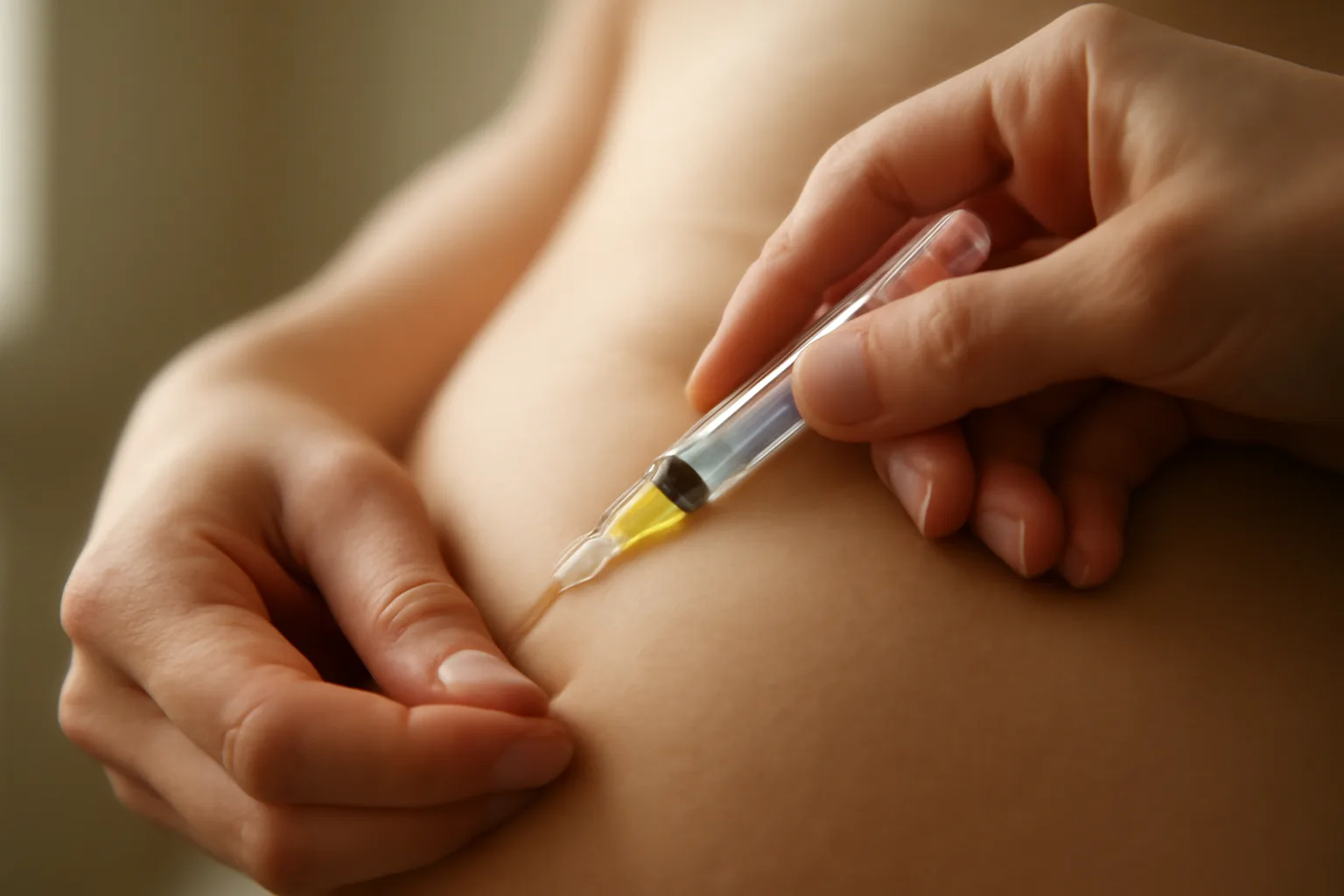
PT-141 (bremelanotide) is injected just under the skin, not into muscle. The two practical sites are the abdomen, at least an inch from the belly button, and the front or outer part of the thigh. These are the same general zones people use for insulin or fertility injections, chosen because the subcutaneous fat layer there is easy to pinch and reasonably free of major nerves or vessels. The FDA-approved version, Vyleesi, ships as a single-dose auto-injector loaded with 1.75 mg of bremelanotide, designed for the patient to use at home without drawing up a dose from a vial [1]. That device format shapes the injection site choice too: the auto-injector is built for abdomen or thigh use, not the arm. Rotating sites matters more than people expect. Injecting the same quarter-inch of skin every time for weeks leads to small bruises, lumps of scar-like tissue (lipohypertrophy), or spots that just stop absorbing the drug well. None of this is unique to PT-141; it's basic subcutaneous injection technique shared with insulin and hormone therapy protocols. For a full walkthrough of technique, needle angle, and skin prep, see PT-141 how to inject.
Is PT-141 injected subcutaneously or intramuscularly?
Subcutaneously. That's a meaningful distinction, not a technicality. Subcutaneous means the needle goes into the fatty layer between skin and muscle, at a shallow angle, using a short needle. Intramuscular injections go deeper, hurt more, and are not how bremelanotide is dosed in any of its studied or approved forms. The two phase 3 trials that got bremelanotide approved, known as the RECONNECT studies, dosed it as a subcutaneous injection self-administered by patients [1] [2]. Every dosing guideline, safety profile, and side effect table tracing back to those trials assumes subcutaneous delivery. If you've seen intramuscular injection discussed for PT-141 anywhere, that's not consistent with the approved product or its trial data. The practical upside of subcutaneous dosing is that it's genuinely something most adults can learn to do themselves after one supervised demonstration, similar to how people learn to self-inject GLP-1 drugs or insulin.
Why does PT-141 work centrally instead of like sildenafil?
This is the single most useful thing to understand about bremelanotide, and it explains why the injection site doesn't change how the drug reaches its target. Sildenafil (Viagra) works locally and vascularly: it increases blood flow to genital tissue by blocking an enzyme (PDE5), which only helps if arousal signaling from the brain is already happening. Bremelanotide works upstream of that, in the brain itself. It's a melanocortin receptor agonist. It activates MC3R and MC4R receptors in the central nervous system, the same receptor family involved in appetite and energy regulation, which is part of why nausea is such a common side effect [3] [4]. A 2022 review in CNS Spectrums describes the drug's action on hypothalamic pathways tied to sexual desire and arousal, distinct from the vascular mechanism of PDE5 inhibitors [5]. Because the effect starts in the brain, not the genital vasculature, it doesn't matter whether the injection goes into the abdomen or the thigh. Absorption from either site reaches systemic circulation and crosses into the central pathways bremelanotide targets. This is also why bremelanotide is studied for conditions like obesity and metabolic regulation through the same melanocortin system, a completely separate line of research from its use for desire [3] . For a deeper look at the receptor biology, see PT-141 peptide.
How long before activity should you inject PT-141?
The labeled timing is about 45 minutes before anticipated sexual activity. In the RECONNECT phase 3 trials, patients self-administered subcutaneous bremelanotide roughly 45 minutes before anticipated activity, and that timing carried through to FDA labeling [1] [2]. This isn't an on-demand drug you take at the exact moment you want it to work, and it isn't a daily drug either. It sits in between: dosed as needed, but with a real lag between injection and effect. Some people notice effects starting sooner, some later; individual absorption varies by injection site fat thickness, local blood flow, and other factors that aren't well characterized in published data. A phase 2b dose-ranging study found that responder rates (patients reporting meaningful improvement) varied by dose level, which is part of why the approved dose settled at 1.75 mg rather than the higher doses tested earlier in development . For dose-by-dose detail, see PT-141 dosage.
How often can you inject PT-141, and does the site matter for frequency limits?
The label caps use at once every 24 hours and no more than 8 doses per month [1]. This limit isn't about running out of injection sites; skin can generally tolerate more frequent subcutaneous dosing than that. It's a pharmacologic and safety limit tied to how the drug affects blood pressure and the cumulative side effect burden seen in trials. A 2022 safety profile analysis pooling data across the bremelanotide clinical development program described nausea, flushing, and injection site reactions as the most frequently reported adverse events, with nausea affecting a substantial share of users, especially at first dose [6]. Because of this, spacing doses out and never exceeding the monthly cap isn't just a formality, it's how the tolerability data was actually generated. For guidance on total treatment duration and whether continuous use makes sense, see PT-141 cycle length.
What does the injection feel like, and what should you expect at the site afterward?
Most people describe it as a quick pinch, similar to an insulin injection, followed by a few seconds of mild sting as the fluid disperses under the skin. It is not comparable to an intramuscular flu shot in depth or discomfort. Injection site reactions are common enough to be listed explicitly in the safety data from bremelanotide's clinical program: redness, mild swelling, and small bruises at the site are frequently reported, though generally described as mild and self-limited [6] [7]. A small bump that resolves within a day or two is normal. A site that's increasingly warm, spreading redness, or pain that worsens over 48 hours is not typical and warrants a call to the prescriber. Rotating between abdomen and thigh, and moving at least an inch from the last injection point, meaningfully reduces how often these reactions show up. This is basic subcutaneous injection hygiene, not specific to bremelanotide.
What are the most common side effects, and are they related to injection site or the drug itself?
| Nausea | Most common; higher at first dose [6] |
|---|---|
| Flushing | Second most common [2] |
| Headache | Reported, less frequent than nausea [7] |
| Injection site reactions | Common but generally mild [6] |
| Blood pressure increase (transient) | Documented, relevant for hypertension history |
Nausea and flushing are the two side effects everyone considering PT-141 should know about upfront, and they are not injection-site phenomena. They come from the drug's central mechanism, not from where the needle goes in. In the two RECONNECT phase 3 trials, nausea was reported by a substantial proportion of women taking bremelanotide, considerably more than placebo, and flushing was the second most common complaint [2]. A pooled safety analysis across the full clinical development program confirmed nausea as the leading adverse event, with rates declining somewhat with repeated dosing in some patients, though not disappearing entirely for everyone [6]. | Side effect | Frequency pattern reported in trials | A 2022 review in Medicina examined bremelanotide use specifically in women with hypertension and underlying sexual dysfunction, noting that transient blood pressure increases are a real consideration for that population and warrant closer monitoring, not a blanket contraindication . If you have uncontrolled high blood pressure or cardiovascular disease, this is a conversation for your prescriber before your first dose, not after.
Does PT-141 actually work? What do the trials show about effect size?
It works better than placebo, but the effect size is genuinely modest, and that honesty matters more than marketing enthusiasm here. The two RECONNECT phase 3 trials, published in Obstetrics and Gynecology in 2019, found statistically significant improvements in desire and reductions in distress related to low desire, measured by validated questionnaires, compared to placebo [2]. But not everyone agrees the clinical significance matches the statistical significance. A 2024 analysis in the Journal of Sex Research titled "Small Effects, Questionable Outcomes" argued that the actual magnitude of improvement on desire scales was small enough to question whether it translates to meaningful real-world benefit for the average patient . A separate 2021 re-analysis of the same phase III data, also in the Journal of Sex Research, raised similar concerns about how "responder" was defined in the original trials . A 2021 piece in Drug and Therapeutics Bulletin went further, comparing bremelanotide to flibanserin (the other FDA-approved drug for low desire) and arguing that regulatory approval of both drugs set a precedent based on modest trial data rather than clearly meaningful benefit [8]. This is a legitimate, published scientific debate, not fringe skepticism, and prospective patients deserve to know it exists before they decide whether the side effect burden is worth it for them.
Who is PT-141 actually approved for?
Vyleesi (bremelanotide) is FDA-approved specifically for premenopausal women with acquired, generalized hypoactive sexual desire disorder (HSDD), not for general low libido, not for men, and not for postmenopausal women [1] [9]. "Acquired" means desire was normal before and declined; "generalized" means it's not limited to one partner or situation. HSDD itself is a specific diagnosis, more than "low interest in sex." A 2021 review in the Journal of Midwifery & Women's Health lays out the diagnostic criteria and notes that HSDD involves persistent or recurrent deficient desire causing marked distress, not simply a preference difference between partners [9]. That distress component is part of the formal diagnosis, and it's why a prescriber should be involved in diagnosis rather than someone self-diagnosing off a symptom checklist. Use outside this population (men, postmenopausal women, or off-label reasons) has far less trial data behind it and isn't what the approval or the safety data actually covers.
How is Vyleesi supplied, and does that affect where you inject?
Vyleesi comes as a single-dose, disposable auto-injector pre-filled with 1.75 mg of bremelanotide, meant to be used once and thrown away, not refilled or reused [1]. This delivery format is part of why the FDA approval specifically describes abdomen and thigh as the intended sites: the auto-injector's needle length and injection mechanism are calibrated for a subcutaneous injection at those locations. Bremelanotide's approval in 2019 was covered in a broader review of that year's peptide and oligonucleotide drug approvals (the "TIDES" category), noting it as one of a wave of new peptide therapeutics reaching market that year . That context matters: peptide drugs generally can't be taken as a pill because stomach acid and enzymes break them down before they'd ever reach the bloodstream, which is exactly why bremelanotide is injectable rather than oral. Some early formulation research even explored delivering it as a nasal spray before the injectable form was the one that reached approval [10] [11]. For how to store the auto-injector, temperature limits, and shelf life once it's out of the fridge, see PT-141 storage and shelf life.
How does bremelanotide's half-life affect injection timing and site absorption?
Bremelanotide has a relatively short half-life, which is part of why it's dosed as-needed rather than daily. Absorption from a subcutaneous injection reaches peak blood levels within roughly an hour or so, consistent with the labeled 45-minute pre-activity timing, and the drug clears from the body over the following hours [1]. Injection site itself (abdomen versus thigh) hasn't been shown in published data to meaningfully change how fast or how completely the drug is absorbed; both are standard subcutaneous fat depots with comparable blood supply. What does affect absorption more is technique: injecting into a bruised or scarred area, or into muscle instead of fat, could plausibly change uptake, though this isn't specifically studied for bremelanotide. For the full pharmacokinetic picture and how it compares across doses, see PT-141 half life.
Where should you actually source PT-141, and does that affect what you're injecting?
This matters more than most people realize. FDA-approved Vyleesi is a single, tested, quality-controlled product with a known 1.75 mg dose per auto-injector. Compounded bremelanotide, sold by some telehealth clinics and research chemical sites, is a different thing entirely, made by a compounding pharmacy or vendor rather than the drug's manufacturer, and not FDA-approved as a finished product. Bremelanotide is not on FDA's 503A bulk drug substances list for human compounding as of the current published list, which means compounding it for patients sits in a regulatory gray zone rather than a clearly sanctioned one [12] [13]. The bulk substance nomination process for 503A compounding is public and ongoing, and prescribers or patients can check FDA's current list directly [14]. If you're getting a prescription, working with a provider who prescribes the FDA-approved product and fills through a legitimate, provider-reviewed pharmacy relationship, rather than an unverified vendor, is the safer route both for dosing accuracy and for knowing what's actually in the syringe. Bremelanotide Rx works from that same provider-reviewed model, connecting patients to legitimate prescribing pathways rather than self-sourced peptide vials of unknown purity.
What should you do if you notice a problem at the injection site or elsewhere?
A small bruise, mild redness, or brief itchiness at the site is common and typically resolves on its own within a day or two [6] [7]. Persistent lumps, spreading redness, warmth, or pain that increases rather than fades over 48 hours is not typical and should prompt a call to whoever prescribed the medication. Beyond the injection site itself, nausea severe enough to interfere with daily activity, a significant blood pressure spike, or new chest pain or severe headache after dosing are reasons to stop and seek medical advice rather than push through and re-dose. Bremelanotide's safety profile across its development program was generally described as manageable, with most adverse events rated mild to moderate, but "generally manageable" is a population-level statement, not a guarantee for any individual patient [6]. If you're new to self-injection generally, having a nurse or prescriber walk through the first dose in person, rather than learning purely from a package insert, meaningfully reduces both anxiety and technique errors.
Frequently asked questions
Can PT-141 be injected in the arm?
The approved sites are the abdomen and the front of the thigh, not the arm. Vyleesi's auto-injector is designed for those two locations. The arm has less accessible subcutaneous fat for most people and isn't part of the studied or labeled injection sites [1].
Does it matter if I inject PT-141 into muscle by accident?
It's designed for subcutaneous, not intramuscular, delivery. An accidental intramuscular injection likely won't cause serious harm, but it may change absorption speed and increase discomfort at the site. If it happens once, don't panic; if you're consistently unsure of your technique, ask your prescriber for a hands-on demonstration.
How do I rotate injection sites for PT-141?
Alternate between the abdomen and the thigh, and move at least an inch from your last injection point each time. Keeping a simple mental or written log of which side or spot you used last helps avoid repeatedly hitting the same small area, which is what causes bruising and lumps.
Why do I feel nauseous after injecting PT-141?
Nausea comes from bremelanotide's action on central melanocortin receptors, not from the injection itself [3] [7]. It's the most commonly reported side effect in clinical trials, often stronger with the first few doses, and was reported significantly more than placebo in the phase 3 RECONNECT trials [2] [5].
Is PT-141 the same as female Viagra?
No, and the mechanism difference is the key point. Sildenafil (Viagra) increases genital blood flow vascularly. Bremelanotide acts centrally on brain melanocortin receptors tied to desire [3] [19]. A 2006 paper literally titled "Bremelanotide: the female Viagra?" explored this comparison and the distinction still holds [14].
How long does a PT-141 injection take to work?
The label directs use about 45 minutes before anticipated sexual activity, based on timing used in the RECONNECT phase 3 trials [1] [2]. Individual onset can vary; it is not an immediate, on-contact effect like a topical product.
Can I inject PT-141 every day?
No. The FDA label caps use at one dose per 24 hours and a maximum of 8 doses per month [1]. This limit reflects safety data from the clinical trials, particularly around blood pressure effects and cumulative nausea, more than a dosing suggestion.
What does an injection site reaction from PT-141 look like?
Usually mild redness, slight swelling, or a small bruise that fades within a day or two. These were among the most frequently reported adverse events in the pooled bremelanotide safety analysis, generally described as mild [5]. Worsening redness, warmth, or pain beyond 48 hours isn't typical.
Is compounded PT-141 the same as FDA-approved Vyleesi?
No. Vyleesi is the FDA-approved, quality-controlled 1.75 mg auto-injector product. Compounded bremelanotide comes from a separate supply chain, and the drug is not clearly listed on FDA's 503A bulk compounding substances list, which puts sourcing in a gray area worth discussing with a prescriber [11] [12].
Does PT-141 cause weight loss through the same mechanism as the injection?
Separately from its use for desire, bremelanotide's central melanocortin activity has been studied for effects on body weight. A 2022 phase 1 analysis in obese women found measurable effects on body weight, which is being researched independently of its HSDD use [22]. This isn't the reason it's prescribed or injected for sexual desire.
Who should not inject PT-141 at all?
It is approved only for premenopausal women with acquired, generalized HSDD [1] [4]. People with uncontrolled hypertension or cardiovascular disease need a specific conversation with their prescriber, since transient blood pressure increases are documented in trial data [24]. It is not approved for men or postmenopausal women.
Can I reuse a PT-141 auto-injector or split a dose across two sites?
No. The Vyleesi auto-injector is single-dose and disposable; it isn't designed to be reused or partially administered across two injection sites [1]. Using it as labeled, one full injection at one site, is how the approved dosing and safety data were established.
Sources
- Bremelanotide: First Approval, Drugs (2019), PMID 31429064: Vyleesi is a single-dose subcutaneous auto-injector containing 1.75 mg bremelanotide, dosed as needed up to once per 24 hours and 8 times monthly, roughly 45 minutes before activity
- Bremelanotide for the Treatment of Hypoactive Sexual Desire Disorder: Two Randomized Phase 3 Trials, Obstetrics and Gynecology (2019), PMID 31599840: The RECONNECT phase 3 trials used subcutaneous self-administered bremelanotide and found nausea and flushing were the most common adverse events, with statistically significant desire improvement over placebo
- Targeting the central melanocortin system for the treatment of metabolic disorders, Nature Reviews Endocrinology (2023), PMID 37365323: Melanocortin receptors (MC3R/MC4R) are central nervous system targets involved in both appetite regulation and other physiologic pathways, explaining bremelanotide's non-vascular mechanism
- Hypoactive Sexual Desire Disorder in Women: Physiology, Assessment, Diagnosis, and Treatment, Journal of Midwifery & Women's Health (2021), PMID 34510696: HSDD is diagnosed as persistent, distressing, acquired and generalized loss of desire, not simply a preference mismatch between partners
- Safety Profile of Bremelanotide Across the Clinical Development Program, Journal of Women's Health (2022), PMID 35147466: Nausea, flushing, and injection site reactions were the most frequently reported adverse events across bremelanotide's pooled clinical trial data, generally mild in severity
- Ligands for Melanocortin Receptors: Beyond Melanocyte-Stimulating Hormones and Adrenocorticotropin, Biomolecules (2022), PMID 36291616: Melanocortin receptor agonism links to nausea and appetite-related effects as part of the receptor family's broader physiology
- Bremelanotide: New Drug Approved for Treating Hypoactive Sexual Desire Disorder, The Annals of Pharmacotherapy (2020), PMID 31893927: Headache and injection site reactions are reported adverse events for bremelanotide, generally less frequent than nausea
- FDA, Bulk Drug Substances Used in Compounding Under Section 503A: FDA maintains a formal process and list governing which bulk drug substances may be used in 503A pharmacy compounding for human drugs
- 21 CFR 216.23, the final 503A Bulks List: The 503A bulk drug substances list is codified in federal regulation and defines which substances are approved for compounding use
- FDA, Bulk Drug Substances Nominated for Use in Compounding (current list): FDA publishes and updates a current list of bulk drug substances nominated for compounding consideration, which patients and prescribers can check directly
- Bremelanotide: the female Viagra?, Expert Review of Endocrinology & Metabolism (2006), PMID 30290453: Early literature directly compared bremelanotide's proposed action to sildenafil while noting the distinct mechanism
- Bremelanotide, PMID 31369224 (2006): Early formulation research explored non-injectable delivery routes for bremelanotide before the injectable auto-injector form reached approval
- Bremelanotide and flibanserin for low sexual desire in women: the fallacy of regulatory precedent, Drug and Therapeutics Bulletin (2021), PMID 34642243: A published critique argues the regulatory approval of bremelanotide and flibanserin rested on modest efficacy data relative to their side effect burden
- The neurobiology of bremelanotide for the treatment of hypoactive sexual desire disorder in premenopausal women, CNS Spectrums (2022), PMID 33455598: Bremelanotide acts on hypothalamic melanocortin pathways tied to sexual desire, a central mechanism distinct from vascular PDE5 inhibition
- Small Effects, Questionable Outcomes: Bremelanotide for Hypoactive Sexual Desire Disorder, Journal of Sex Research (2024), PMID 36809187: An independent analysis argues the measured effect size of bremelanotide on desire scores in trials was small enough to question its clinical meaningfulness
- Effect of bremelanotide on body weight of obese women: Data from two phase 1 randomized controlled trials, Diabetes, Obesity & Metabolism (2022), PMID 35170192: Phase 1 trials in obese women measured bremelanotide's effect on body weight, separate from its use for sexual desire
- Management of Hypertension with Female Sexual Dysfunction, Medicina (Kaunas) (2022), PMID 35630054: Bremelanotide use in women with hypertension requires closer monitoring due to documented transient blood pressure increases
- Re-Analyzing Phase III Bremelanotide Trials for "Hypoactive Sexual Desire Disorder" in Women, Journal of Sex Research (2021), PMID 33678061: A re-analysis of the phase III bremelanotide trials raised questions about how treatment responders were defined in the original data
- 2019 FDA TIDES (Peptides and Oligonucleotides) Harvest, Pharmaceuticals (Basel) (2020), PMID 32151051: Bremelanotide's 2019 approval was part of a broader wave of peptide and oligonucleotide drugs reaching market that year