Last updated 2026-07-25
TL;DR
PT-141 (bremelanotide) is given as a subcutaneous injection in the thigh or abdomen, roughly 45 minutes before anticipated sexual activity, using the prefilled autoinjector approved as Vyleesi. It works on melanocortin receptors in the brain, not blood vessels, so timing and site matter less for onset than for avoiding nausea and flushing, the two most common side effects reported in trials.
What is PT-141 and how is it approved to be given?
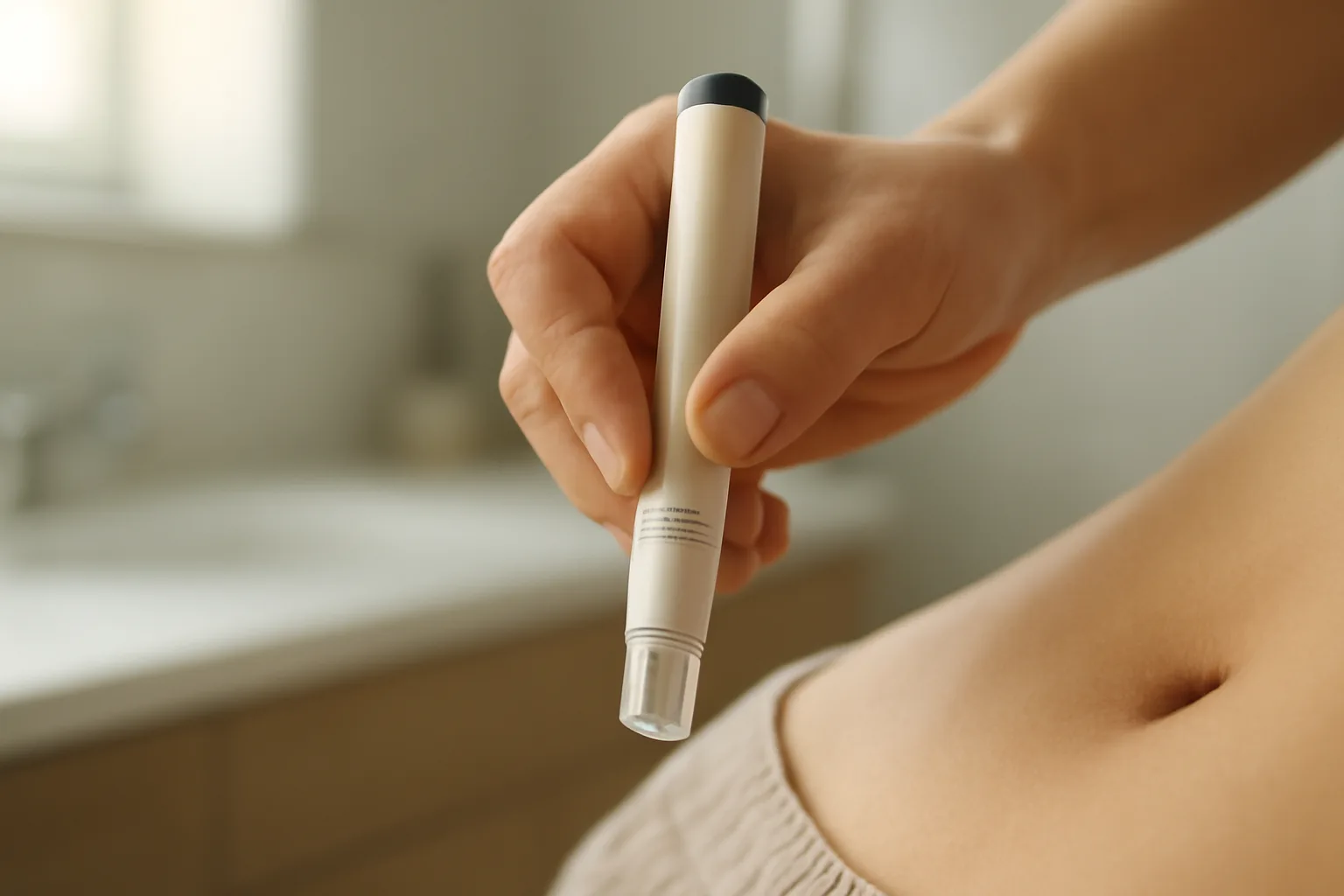
PT-141 is the research name for bremelanotide, a melanocortin receptor agonist approved by the FDA in 2019 under the brand name Vyleesi for hypoactive sexual desire disorder (HSDD) in premenopausal women [1]. The approved product is a single-dose, prefilled autoinjector delivering 1.75 mg subcutaneously, meant to be self-administered in the abdomen or thigh [1][2]. This is not an oral drug and not a cream. It's a needle, a small one, and the FDA approval covers exactly one delivery method: subcutaneous injection with the autoinjector pen. Anything sold as PT-141 outside that approved product (vials, nasal sprays, compounded formulations) is not going through the same regulatory review, and dosing accuracy and sterility can't be assumed the same way [1]. If you want the fuller pharmacology and trial history first, the PT-141 peptide overview is a good place to start before you get into injection mechanics.
Where on the body do you inject PT-141?
The approved injection sites are the abdomen and the thigh, rotated between doses to reduce local irritation [1][2]. Most people use the abdomen, at least two inches from the navel, or the front or outer thigh. Site choice doesn't change how fast the drug reaches the brain in any clinically meaningful way that's been separately studied for bremelanotide; unlike vascular drugs, its job is to reach melanocortin-4 receptors in the central nervous system, not to act locally at the injection site [3][4]. So the main reason to rotate sites is comfort and skin health, not pharmacokinetics. For a longer breakdown of site rotation schedules and technique differences between abdomen and thigh, see PT-141 injection sites.
How do you actually give the injection, step by step?
The autoinjector is designed for a fairly simple sequence, and the process mirrors other prefilled autoinjector pens used for subcutaneous drugs: 1. Wash your hands and pick a clean, dry injection site (abdomen or thigh). 2. Wipe the site with an alcohol swab and let it air-dry for a few seconds. 3. Remove the cap from the autoinjector just before use. 4. Press the device firmly against the skin at a 90-degree angle. 5. Activate the injection per the device's mechanism (a button press or firm push, depending on the pen design) and hold in place until you hear or feel the injection complete. 6. Remove the device and dispose of it in a sharps container. Do not reuse. Because Vyleesi ships as a single-dose autoinjector, there's no drawing up from a vial, no measuring, and no reused needles in the approved product. That's part of the appeal for people worried about dosing errors, and it's also why compounded vial versions carry more room for user error since they require manual drawing and injecting.
When should you inject PT-141 relative to sex?
The approved labeling and the phase 3 RECONNECT trials had women self-administer bremelanotide as needed, at least 45 minutes before anticipated sexual activity [5][6]. It is not taken on a fixed daily schedule; it's used episodically, tied to when intimacy is expected. That 45-minute window exists because bremelanotide works centrally: it has to cross into the brain and act on melanocortin-4 receptors involved in sexual arousal pathways, which takes time, unlike a topical vasodilator with a local, faster effect [3][4]. Trials also limited use to no more than one dose within 24 hours and no more than 8 doses per month, and that dosing ceiling matters for anyone planning to use it more than occasionally [5]. For exact frequency limits and what happens if you exceed them, the PT-141 dosage page covers the numbers in more detail.
Why does the injection route matter for how PT-141 works?
This is the detail most people get wrong: PT-141 does not work like sildenafil or other PDE5 inhibitors that widen blood vessels in genital tissue. Bremelanotide acts on melanocortin receptors in the central nervous system, a mechanism distinct from the vascular pathway used by erectile dysfunction drugs [3][4]. A 2022 review in CNS Spectrums describes the neurobiology behind this action, tying bremelanotide's effect on desire to melanocortin receptor activity in brain regions tied to sexual motivation, rather than to increased blood flow at the injection site or genitals directly [4]. That's also why the drug is dosed as an as-needed subcutaneous injection instead of a topical or vascular-targeted product: it needs systemic absorption to reach the brain, and subcutaneous delivery gets it into circulation reliably [1][3]. A 2023 review in Nature Reviews Endocrinology on melanocortin system targeting for metabolic and related disorders reinforces that central melanocortin pathways govern a broad set of physiological responses beyond just local tissue effects, which is consistent with why bremelanotide's side effect profile (nausea, blood pressure changes) looks more like a systemic drug than a local one [7].
What side effects should you expect from the injection?
Nausea is the most common side effect reported in bremelanotide's clinical development program, and it isn't rare. A 2022 safety profile analysis across the clinical trial program found nausea affected a substantial share of users, more common at the approved 1.75 mg dose than placebo, along with flushing, headache, and injection site reactions [8]. The two phase 3 RECONNECT trials, published in Obstetrics and Gynecology in 2019, reported nausea in roughly 40% of women on bremelanotide versus about 1% on placebo, with flushing in roughly 20% versus low single digits on placebo [5]. Vomiting occurred in a smaller subset. These aren't trivial rates, and anyone starting the drug should expect nausea as a real possibility on the first few doses, not a fluke. Injection site reactions (redness, swelling, mild bruising) are also common and generally resolve on their own [8][5]. Because bremelanotide can transiently raise blood pressure, it's specifically not recommended for people with uncontrolled hypertension or known cardiovascular disease, and a 2022 review in Medicina addressed how this factors into treatment decisions for women with hypertension and sexual dysfunction . A 2020 review in The Annals of Pharmacotherapy summarizing the drug's approval also flagged focal hyperpigmentation (darkening of skin, particularly on the face and gums) with repeated use as a less common but notable long-term effect [9].
How well does the injection actually work?
In the RECONNECT trials, bremelanotide produced statistically significant but modest improvements over placebo on validated measures of sexual desire and desire-related distress [5]. A 2022 subgroup analysis of the same RECONNECT data, published in the Journal of Women's Health, found the treatment effect held up across prespecified subgroups, though the magnitude remained small in absolute terms [10]. Not everyone agrees the size of that benefit justifies routine use. A 2021 re-analysis published in the Journal of Sex Research argued the clinical significance of the trial results was overstated relative to the actual size of the desire score improvements . A related 2024 paper in the same journal, titled "Small Effects, Questionable Outcomes," made a similar argument about the gap between statistical significance and meaningful day-to-day difference for patients . A 2021 piece in Drug and Therapeutics Bulletin extended this skepticism to both bremelanotide and flibanserin, questioning what it called the fallacy of regulatory precedent used to justify approval of drugs for low sexual desire in women [11]. This doesn't mean the drug does nothing. It means the honest answer is: some people respond meaningfully, the average effect size in trials was real but small, and expectations matter. A phase 2b dose-ranging study identified responder rates at different doses, providing some of the basis for landing on the 1.75 mg autoinjector dose used today .
What if you inject it and nothing happens?
Bremelanotide isn't a guaranteed same-session arousal trigger the way it's sometimes marketed. In the phase 3 trials, response was measured over weeks of use, not a single encounter, and only a portion of participants met the trial's definition of a meaningful responder [5]. If you've used it several times at the correct dose, timing, and site and don't notice a difference, that's consistent with what the controlled trials found: not universal response. It's not evidence you're doing the injection wrong. Talk to the prescribing clinician before increasing frequency past the 8-dose monthly limit used in trials, since going beyond studied dosing means going beyond the safety data collected [5].
Can you inject PT-141 alongside other medications, like blood pressure drugs?
Because bremelanotide can transiently raise blood pressure and slow heart rate slightly following injection, clinicians generally weigh this carefully in people already on antihypertensive medication or with cardiovascular disease [8]. This is exactly the kind of thing a prescriber needs to know before you start, not something to self-manage. A 2022 review in The Urologic Clinics of North America on medical treatment options for female sexual dysfunction places bremelanotide's cardiovascular caution alongside other prescribing considerations for this drug class [12]. If you're on blood pressure medication, disclose it before your first dose, and don't assume an as-needed injectable is automatically low-risk just because it isn't a daily pill.
How do injection frequency and cycle length interact?
Trials capped use at one dose per 24 hours and a maximum of 8 doses per month [5]. That's not an arbitrary caution; it's the frequency ceiling under which safety and efficacy were actually measured, so going past it means you're in unstudied territory. Some people use it far less often than 8 times a month, tied only to specific planned intimacy. Others approach the monthly cap more consistently. Neither is wrong on its face, but going over the studied cap isn't something to do without checking in with the prescribing clinician first. For how this maps onto broader usage patterns and rest periods, see PT-141 cycle length.
How long does the injection's effect last, and does that affect timing?
Bremelanotide's half-life and duration of measurable central effect determine both the 45-minute pre-activity window and the 24-hour minimum spacing between doses used in trials [5]. Because the effect isn't instantaneous and isn't infinitely prolonged, timing the injection appropriately before anticipated activity, rather than immediately beforehand, matters more than exact injection site choice. For the specific pharmacokinetic numbers behind these timing windows, the PT-141 half life page breaks down absorption and clearance in more detail than fits here.
How should PT-141 autoinjectors be stored between uses?
Prefilled autoinjectors and any peptide product need consistent, cool storage to preserve potency; heat and repeated temperature swings degrade peptide drugs faster than tablets. Check the specific product's storage requirements before each use, and never inject a device that's been left in a hot car, direct sun, or a bag for an extended period. Detailed storage temperature ranges and shelf-life expectations are covered in PT-141 storage and shelf life, which is worth reading before your first shipment arrives, not after.
Where does a legitimate, provider-reviewed injection come from?
The only FDA-approved bremelanotide product is Vyleesi, and it's listed in the FDA's Drugs@FDA database along with its approved labeling and dosing [1]. That's the version with phase 3 trial data behind its safety and dosing instructions [5]. Outside of that approved product, bremelanotide compounded from bulk substance falls under different regulatory categories. The FDA maintains lists of bulk drug substances allowed for compounding under Section 503A and 503B of the FD&C Act, and pharmacy compounding is separately governed under 21 U.S.C. 353a . Whether bremelanotide appears on those lists, and under what conditions, changes over time, so anyone considering a compounded version should ask the pharmacy directly which regulatory pathway their product uses and request documentation. Bremelanotide Rx does not compound or manufacture bremelanotide. If you're ready to move forward, the practical next step is a provider-reviewed consultation that checks your blood pressure history, current medications, and prior response, before the prescription is routed to a fulfilling pharmacy for dispensing under proper oversight.
Frequently asked questions
How long before sex do you inject PT-141?
The phase 3 RECONNECT trials had participants self-inject bremelanotide at least 45 minutes before anticipated sexual activity [11]. This window exists because the drug works centrally on brain melanocortin receptors, which takes longer to produce an effect than a locally acting vascular drug.
Where do you inject PT-141 on the body?
The FDA-approved autoinjector is used on the abdomen (at least two inches from the navel) or the thigh, with sites rotated between doses to reduce irritation [1][2]. Site choice affects comfort more than speed of effect, since the drug needs to reach the brain, not the injection site.
How many times a month can you inject PT-141?
Clinical trials limited use to one dose per 24 hours and no more than 8 doses per month [11]. Going beyond that frequency means going outside the range where safety and efficacy were actually measured, so check with a prescriber before exceeding it.
What does PT-141 nausea feel like and how common is it?
Nausea was reported in roughly 40% of women receiving bremelanotide in the RECONNECT phase 3 trials, compared to about 1% on placebo [11]. It's typically most noticeable after the first few doses and tends to lessen with continued use for many people, though not everyone.
Does PT-141 work the same way as Viagra?
No. Bremelanotide acts centrally on melanocortin receptors in the brain tied to sexual desire pathways, while PDE5 inhibitors like sildenafil work locally by increasing blood flow to genital tissue [7][19]. That's why bremelanotide is approved for low desire in women rather than for erectile or arousal blood-flow problems.
Can you inject PT-141 if you have high blood pressure?
Bremelanotide can cause a transient rise in blood pressure after injection, so it needs careful review for anyone with uncontrolled hypertension or cardiovascular disease [5][22]. Disclose all blood pressure medications and cardiovascular history to the prescribing clinician before starting.
Why does PT-141 cause skin flushing?
Flushing is a commonly reported side effect in bremelanotide's clinical trials, occurring in roughly 20% of treated participants versus low single digits on placebo [11][5]. It's tied to the drug's systemic melanocortin receptor activity rather than to the injection site itself.
Is PT-141 injected with a needle you can see, and does it hurt?
Yes, the approved Vyleesi product uses a small prefilled autoinjector for subcutaneous injection, similar in concept to an EpiPen-style device [1]. Injection site reactions like redness or mild bruising are commonly reported but generally resolve without treatment [5].
What happens if PT-141 doesn't work for you?
Not everyone responds. Trial data shows a real but modest average effect size, and some independent re-analyses have questioned whether the improvement is meaningful for every patient [21][24]. If several correctly timed doses produce no noticeable difference, that's consistent with published response rates, not necessarily an injection technique problem.
Can PT-141 be taken as a pill instead of injected?
The FDA-approved product, Vyleesi, is only available as a subcutaneous autoinjector, not an oral tablet [1]. Some research has explored alternative peptide delivery routes, including transbuccal patches, but these remain experimental and are not part of the approved product [29].
Does PT-141 cause skin darkening with repeated use?
Yes, focal hyperpigmentation, particularly of the face and gums, has been reported with repeated bremelanotide use in clinical review literature, though it's less common than nausea or flushing [8]. Report any new skin darkening to your prescriber.
Is compounded PT-141 the same as the FDA-approved injection?
No. Vyleesi is the only FDA-approved bremelanotide product, reviewed through phase 3 trials for dosing and safety [1][11]. Compounded versions fall under separate FDA bulk substance and pharmacy compounding rules (21 U.S.C. 353a; 21 CFR 216.23-216.24), and quality oversight can differ from the approved product [27][28][30].
Sources
- PubMed, Bremelanotide: First Approval (Drugs, 2019): Bremelanotide was FDA-approved in 2019 as Vyleesi, a single-dose prefilled autoinjector for subcutaneous self-administration in premenopausal women with HSDD.
- PubMed, Bremelanotide (Vyleesi) for hypoactive sexual desire disorder (The Medical Letter, 2019): The approved autoinjector is used at the abdomen or thigh with sites rotated between doses.
- PubMed, Safety Profile of Bremelanotide Across the Clinical Development Program (J Women's Health, 2022): Nausea, flushing, and injection site reactions were the most common adverse events across the bremelanotide clinical development program.
- PubMed, Targeting the central melanocortin system for the treatment of metabolic disorders (Nat Rev Endocrinol, 2023): Central melanocortin pathways govern systemic physiological responses beyond local tissue effects.
- PubMed, Melanocortins in the treatment of male and female sexual dysfunction (Curr Top Med Chem, 2007): Bremelanotide's action on melanocortin receptors is a central nervous system mechanism distinct from vascular-acting drugs.
- PubMed, Bremelanotide: New Drug Approved for Treating Hypoactive Sexual Desire Disorder (Ann Pharmacother, 2020): Focal hyperpigmentation of the face and gums has been reported with repeated bremelanotide use.
- PubMed, Medical Treatment of Female Sexual Dysfunction (Urol Clin North Am, 2022): Cardiovascular caution is a key prescribing consideration for bremelanotide among female sexual dysfunction treatments.
- PubMed, Bremelanotide for the Treatment of Hypoactive Sexual Desire Disorder: Two Randomized Phase 3 Trials (Obstet Gynecol, 2019): RECONNECT trials dosed bremelanotide at least 45 minutes before sexual activity, capped at one dose per 24 hours and 8 doses per month, with nausea in about 40% and flushing in about 20% of treated participants versus placebo.
- PubMed, Prespecified and Integrated Subgroup Analyses from the RECONNECT Phase 3 Studies of Bremelanotide (J Women's Health, 2022): Subgroup analysis of RECONNECT data found the treatment effect held across prespecified subgroups, though modest in magnitude.
- PubMed, Bremelanotide and flibanserin for low sexual desire in women: the fallacy of regulatory precedent (Drug Ther Bull, 2021): A critical review questioned the regulatory basis used to justify approval of bremelanotide and flibanserin for low sexual desire.
- PubMed, The neurobiology of bremelanotide for the treatment of hypoactive sexual desire disorder in premenopausal women (CNS Spectrums, 2022): Bremelanotide's effect on desire is tied to melanocortin receptor activity in brain regions involved in sexual motivation, not local blood flow.
- PubMed, Small Effects, Questionable Outcomes: Bremelanotide for Hypoactive Sexual Desire Disorder (J Sex Res, 2024): Analysis argues the clinical meaningfulness of bremelanotide's trial effect sizes is questionable despite statistical significance.
- PubMed, Management of Hypertension with Female Sexual Dysfunction (Medicina, 2022): Bremelanotide's blood pressure effects require careful management in women with hypertension considering treatment for sexual dysfunction.
- PubMed, Responder Analyses from a Phase 2b Dose-Ranging Study of Bremelanotide (J Sex Med, 2019): Phase 2b dose-ranging responder analysis helped establish the dose used in the approved 1.75 mg autoinjector.
- PubMed, Re-Analyzing Phase III Bremelanotide Trials for HSDD in Women (J Sex Res, 2021): A re-analysis of phase 3 trial data argued the clinical significance of bremelanotide's effect was overstated relative to its actual magnitude.
- FDA, Drugs@FDA database: Vyleesi is listed as the FDA-approved bremelanotide product with its official labeling.
- FDA, bulk drug substances used in compounding under section 503A: FDA maintains a list governing which bulk drug substances, potentially including bremelanotide, can be used in 503A pharmacy compounding.
- eCFR, 21 CFR 216.24, the 503B Bulks List: Federal regulation establishes the bulk drug substances list applicable to 503B outsourcing facility compounding.
- PubMed, A biodegradable suction patch for sustainable transbuccal peptide delivery (J Control Release, 2025): Alternative peptide delivery methods beyond injection, such as transbuccal patches, remain in experimental research stages.
- Cornell Law, 21 U.S.C. 353a, pharmacy compounding: Pharmacy compounding of drug products, including bremelanotide when compounded, is governed under this federal statute.