Last updated 2026-07-25
TL;DR
The FDA-approved dose of bremelanotide (Vyleesi/PT-141) is 1.75 mg injected under the skin of the abdomen or thigh, taken as needed at least 45 minutes before anticipated sexual activity, with no more than one dose in 24 hours or eight doses in a month [1]. It works on brain melanocortin receptors, not blood vessels, so timing and food matter less than with erectile drugs but nausea is common.
What is the standard PT-141 dosage?
The dose used in every phase 3 trial and the one FDA approved is 1.75 mg, delivered by subcutaneous injection using a single-dose auto-injector, self-administered into the abdomen or thigh [1][2]. This is a fixed dose. There's no titration schedule where you start low and work up, unlike some other subcutaneous therapies. The drug is taken on an as-needed basis, not daily. You use it when you anticipate sexual activity, not on a fixed calendar. The two phase 3 trials that led to approval, known as RECONNECT, tested exactly this fixed 1.75 mg as-needed regimen in premenopausal women with acquired, generalized hypoactive sexual desire disorder (HSDD) [3]. The original phase 2b dose-ranging study tested a range of doses to find the one with the best balance of effect and tolerability, and responder analyses from that trial helped settle on 1.75 mg as the dose carried into phase 3 . Higher doses in early dose-finding work produced more nausea without proportionally better desire outcomes, which is part of why 1.75 mg became the approved number rather than something higher .
How often can you use PT-141, and is there a maximum dose?
The label limit is one dose in any 24-hour period, and no more than eight doses in a month [1]. That monthly ceiling isn't arbitrary decoration. It reflects both the trial dosing frequency and a real safety concern: bremelanotide raises blood pressure transiently after each dose, and stacking doses too close together compounds that effect . Most people in the trials did not use it every day or even every week. Real-world use tends to be a few times a month, timed around actual anticipated activity rather than routine scheduling. If you find you need it more than eight times in a month to get through, that's worth a conversation with a prescriber about whether the diagnosis and treatment plan still fit, not a reason to just push past the limit. There is no evidence that using it more frequently improves results. The RECONNECT trials measured effect using a fixed as-needed pattern within that monthly cap, and that's the only frequency profile with real outcome data behind it [3].
How long before sex should you take PT-141?
The label instruction is at least 45 minutes before you expect to be sexually active [1][2]. This isn't a hard three-hour window with a strict cutoff. The effect can last several hours once it sets in, which is part of why it's dosed as-needed rather than on a fixed clock. This timing detail is where the mechanism actually matters for real life. PT-141 does not work like sildenafil, which needs blood flow and physical arousal cues already in motion to have anything to amplify. Bremelanotide's effect starts in the brain, activating melanocortin 4 receptors (MC4R) involved in central pathways for sexual desire and arousal, independent of vascular events [4]. That central mechanism is why the drug is dosed ahead of activity rather than in response to it, and why it doesn't require any direct genital stimulation to "activate." The practical tradeoff: you need a bit of planning. It isn't an in-the-moment rescue dose the way some vascular drugs are marketed. Some people take it in the evening well ahead of an anticipated encounter specifically to let early nausea pass before anything else is happening.
Where and how do you inject PT-141?
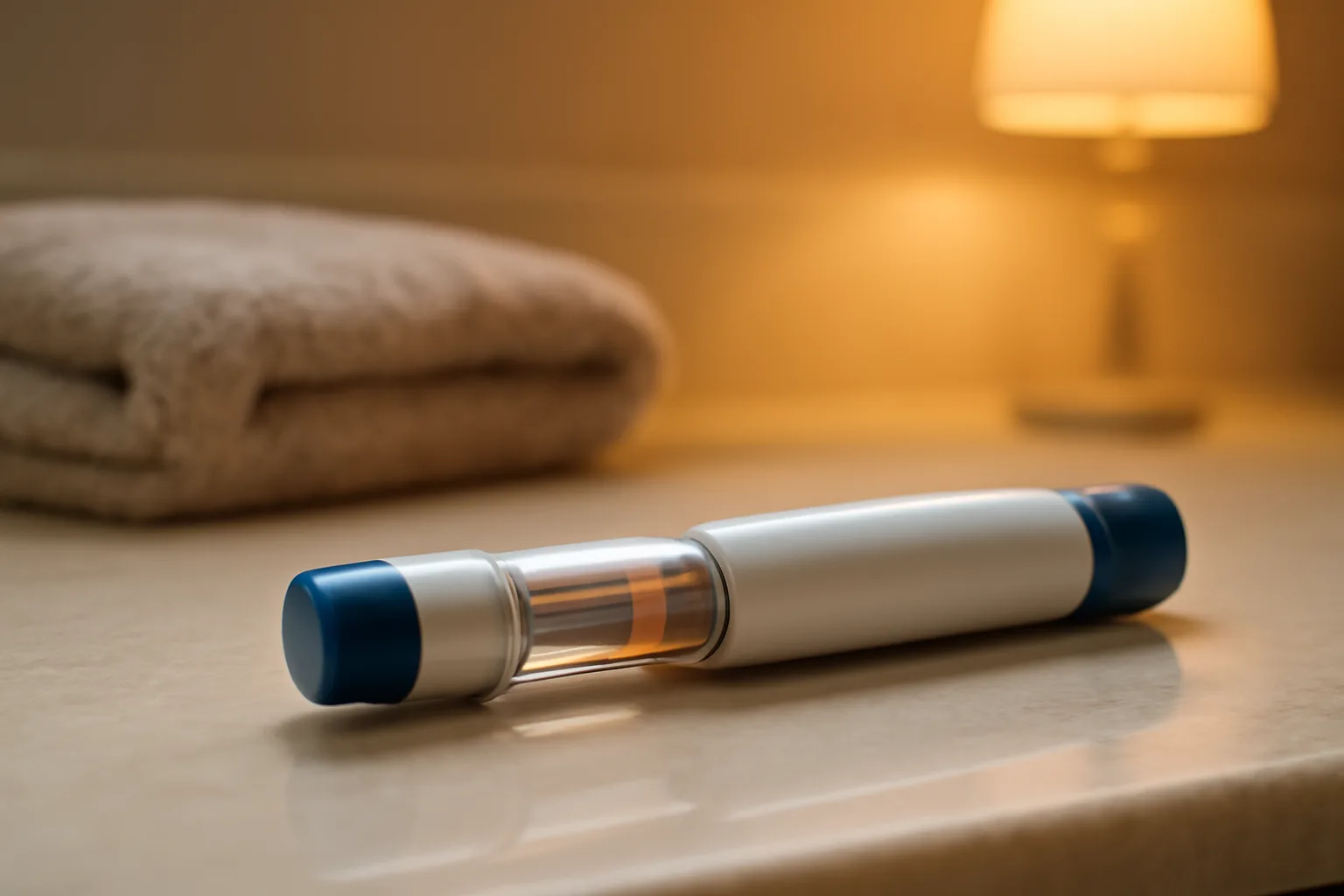
Vyleesi comes as a single-dose auto-injector pre-filled with the 1.75 mg dose, meant for subcutaneous injection into the abdomen or thigh [1]. You rotate injection sites the way you would with other subcutaneous self-injected drugs, to avoid irritation building up in one spot. Each auto-injector is single-use. There's no reconstitution, no drawing up from a vial, no calculating a partial dose. That simplicity is a deliberate design choice from the approved product, and it's one reason the FDA's 2019 approval review flagged bremelanotide among the peptide therapeutics cleared that year under its TIDES (peptides and oligonucleotides) pathway tracking . Compounded versions of PT-141 sold outside the approved Vyleesi product are not the same regulatory category. Bremelanotide is not on FDA's 503A bulk drug substances list for pharmacy compounding [source: 21 CFR 216.23], nor is it on the 503B outsourcing facility bulks list [source: 21 CFR 216.24]. That matters for dosing consistency: an FDA-approved auto-injector has a fixed, tested 1.75 mg dose; a compounded vial or nasal spray does not come with that same manufacturing oversight.
What side effects should you expect at the standard dose?
Nausea is the most common side effect, and it isn't rare or mild for everyone. Across the clinical development program, nausea occurred in a large share of women using bremelanotide, with rates highest after the first dose and dropping off with repeated use [5]. Flushing is the second most common effect, followed by injection site reactions and headache [5][6]. A pooled safety analysis across the full clinical program described bremelanotide's adverse event profile as dominated by these gastrointestinal and vasomotor effects, generally rated mild to moderate, with nausea being the leading cause of study discontinuation [5]. If nausea hits you hard the first time, it tends to matter less on subsequent doses, but some people decide it isn't worth repeating. Blood pressure rises transiently after each dose, which is why it isn't recommended for people with uncontrolled hypertension or known cardiovascular disease, and why the 24-hour and monthly dosing caps exist [1]. A focused review of hypertension and female sexual dysfunction treatment specifically flagged this transient blood pressure increase as a factor prescribers need to weigh against the potential benefit for desire . Focal hyperpigmentation, mainly on the face, gums, and breasts, has been reported with repeated dosing and may not fully resolve after stopping. This is a distinct, less common finding worth asking a prescriber about if you have a history of skin pigmentation changes or plan very frequent use over months.
Does PT-141 work the same way as sildenafil or other ED drugs?
No, and this is the single most important thing to understand before deciding on a dose or a delivery method. Sildenafil and similar drugs work on the vascular system, increasing blood flow to genital tissue by blocking an enzyme (PDE5) that would otherwise let blood vessels constrict. They need a body already responding to stimulation to have an effect to amplify. Bremelanotide is a melanocortin receptor agonist. Its relevant target for HSDD is the MC4 receptor in the central nervous system, part of a signaling system also studied for appetite and metabolic regulation [7]. A recent review of the central melanocortin system's role in metabolic disorders points out that MC4R sits at the intersection of energy balance and multiple behavioral pathways, sexual desire being one of them [7]. This central-versus-vascular distinction explains a few practical things. It's why bremelanotide doesn't require intact blood flow response to "work." It's why it's dosed by anticipated timing rather than as a same-moment rescue. And it's why the side effect profile looks completely different: nausea and transient blood pressure change from central and vasomotor pathways, rather than the visual disturbances or priapism risk profile associated with PDE5 inhibitors.
How well does 1.75 mg actually work in the clinical trials?
In the two RECONNECT phase 3 trials, women treated with bremelanotide 1.75 mg showed statistically significant improvement over placebo on co-primary endpoints measuring sexual desire (Female Sexual Function Index desire domain) and distress related to low desire (Female Sexual Distress Scale-Desire/Arousal/Orgasm item 13), compared with placebo [3]. The effect size is a genuinely contested point in the literature, not a settled win. A re-analysis of the phase 3 data argued the between-group differences, while statistically significant, were small in absolute terms and questioned whether they meet a meaningful clinical difference threshold for patients . A separate critique published in the Journal of Sex Research made a similar point directly in its title: "Small Effects, Questionable Outcomes" for bremelanotide in HSDD . A UK-based Drug and Therapeutics Bulletin piece went further, comparing the regulatory bar used for bremelanotide and flibanserin (the other FDA-approved HSDD drug) and arguing that approval precedent for modest-effect sexual desire drugs deserves scrutiny [8]. Prespecified subgroup analyses from RECONNECT looked at whether effects varied meaningfully by things like age or baseline desire severity, and found broadly consistent direction of effect across subgroups, though this doesn't resolve the absolute effect size debate [9]. The honest summary: bremelanotide beats placebo in the trials that led to approval, but reasonable clinicians and researchers disagree about how much that difference matters to an individual patient's daily life. For context on realistic response, phase 2b responder analyses (before the 1.75 mg dose was locked in for phase 3) found that a meaningful minority, not a majority, of women reached a threshold considered a clinically important individual response, which is a more useful number to know going in than the trial's average effect size alone .
Who should not use PT-141, or needs a dose adjustment?
Vyleesi is approved only for premenopausal women with acquired, generalized HSDD, meaning desire that used to be normal and has decreased, not a lifelong pattern, and not desire loss fully explained by a relationship problem, a medication side effect, or another medical or psychiatric condition [1][10]. It is not approved for postmenopausal women, for men, or for HSDD caused by another identifiable condition. Uncontrolled high blood pressure or known cardiovascular disease are the main safety flags, given the drug's transient blood pressure effect after each dose [1]. People with these conditions need a real conversation with a prescriber, more than a dose reduction, since there's no lower approved dose to fall back to; 1.75 mg is the only studied and approved amount. There's no dedicated renal or hepatic dose-adjustment schedule published for bremelanotide the way there is for many oral drugs, largely because it's dosed as a fixed injectable rather than titrated. If you have significant liver or kidney disease, that's a conversation for your prescriber about candidacy, not a math problem to solve with a smaller injection.
How does PT-141 dosing compare to flibanserin?
Flibanserin (Addyi) is the other FDA-approved drug for HSDD, and it's dosed completely differently: once daily, every night at bedtime, as a pill, with a required alcohol restriction. Bremelanotide is as-needed, injected, and has no alcohol restriction noted on its label the way flibanserin does.
| Feature | Bremelanotide (Vyleesi) | Flibanserin (Addyi) |
|---|---|---|
| Dose | 1.75 mg | 100 mg |
| Route | Subcutaneous injection | Oral tablet |
| Frequency | As needed, max 1/24 hr, max 8/month | Once daily at bedtime |
| Mechanism | Central melanocortin receptor agonist | Serotonin receptor modulator |
| Common side effects | Nausea, flushing, injection site reaction, headache | Somnolence, dizziness, nausea |
| Alcohol interaction | Not a labeled restriction | Contraindicated with alcohol |
A published comparison of the regulatory pathway for both drugs argued that neither should be treated as a template for the other simply because both target HSDD; the mechanisms, dosing logic, and risk profiles genuinely differ [8]. If daily pill-taking and an alcohol restriction sound worse to you than an as-needed injection with nausea risk, that's a legitimate basis for preference, but it isn't a medical equivalence.
Are there other delivery methods or future dosing forms being studied?
Right now, the only FDA-approved delivery is the 1.75 mg subcutaneous auto-injector. Nasal spray and other non-injected formulations of bremelanotide have circulated in research and in some compounded products, but they are not the approved Vyleesi formulation and don't carry the same dosing evidence. Early-stage delivery research is exploring alternatives. One 2025 paper describes a biodegradable suction patch designed for transbuccal (across the cheek lining) peptide delivery, tested as a non-injection route for peptide drugs generally . This is preclinical delivery-technology research, not a bremelanotide product available to patients, and it shouldn't be read as an imminent alternative to the injector. Separately, phase 1 data have looked at bremelanotide's effect on body weight in obese women, tied to its action on the same MC4R pathway involved in appetite regulation, though this is a different research question from HSDD dosing and not an approved use . If you see bremelanotide discussed for weight or metabolic purposes, understand that's investigational and outside the approved indication entirely. If you're weighing the injector against other formats you've seen advertised, our PT-141 vs other HSDD treatments comparison and our how PT-141 works in the brain explainer both go into the mechanism differences that actually drive these formulation choices.
What should a first-time PT-141 dose actually feel like?
Expect the possibility of nausea starting within an hour or two, sometimes with flushing in the face or chest. This is the most commonly reported pattern across the clinical program and tends to be strongest on the first exposure [5]. Blood pressure and heart rate can rise modestly and transiently after the injection; this isn't something you'll necessarily feel, but it's part of why the drug isn't recommended for people with uncontrolled hypertension [1]. A mild headache is also commonly reported [6]. A reasonable first-dose plan: take it on a night with no early morning commitment, in case nausea or a headache shows up and lingers a few hours. Don't plan your first dose right before something time-sensitive. If the first experience is rough, that doesn't necessarily predict every future dose. Trial data show tolerability generally improves with repeated dosing even though the drug itself isn't changing [5]. This is also where working with a provider who reviews your history matters more than the injection technique itself. Bremelanotiderx.com's role is to connect people to that provider-reviewed pathway, working with a licensed fulfilling pharmacy partner rather than compounding or manufacturing anything directly.
Frequently asked questions
What is the standard PT-141 (bremelanotide) dose?
The FDA-approved dose is 1.75 mg, delivered by a single subcutaneous injection using a pre-filled auto-injector into the abdomen or thigh [1]. It's a fixed dose used as-needed, not titrated up or down, and it's the same dose tested in both RECONNECT phase 3 trials that led to FDA approval [11].
How many times a month can you use PT-141?
The label allows a maximum of one dose in any 24-hour period and no more than eight doses per month [1]. This limit exists partly because each dose causes a transient rise in blood pressure, and stacking doses too closely compounds that effect rather than adding benefit [22].
How long before sex do you take PT-141?
At least 45 minutes before anticipated sexual activity, per the FDA label [1]. Because bremelanotide works centrally on brain melanocortin receptors rather than on blood flow, it doesn't need to coincide exactly with stimulation the way vascular drugs like sildenafil do [7][19].
Is PT-141 an injection, pill, or nasal spray?
The FDA-approved product, Vyleesi, is a subcutaneous injection given with a single-dose auto-injector [1][4]. Nasal spray and other non-injected formats exist outside the approved product as compounded versions, but they don't carry the same dosing evidence or manufacturing oversight as the approved auto-injector.
Why does PT-141 cause nausea?
Nausea is the most frequently reported side effect across the bremelanotide clinical development program, tied to its action on central melanocortin receptors, and it's typically strongest after the first dose, decreasing with repeated use [5]. It isn't a sign of an allergic reaction for most people, but persistent or severe nausea is worth discussing with a prescriber.
Can men use PT-141, and is the dose the same?
Vyleesi is FDA-approved only for premenopausal women with acquired, generalized hypoactive sexual desire disorder [1][2]. There is no FDA-approved dose or indication for men; any male use is off-label and outside the studied 1.75 mg regimen, so there's no approved dosing guidance to point to.
How is PT-141 different from sildenafil (Viagra) in terms of dosing logic?
Sildenafil works on vascular blood flow and needs physical arousal already underway to amplify. Bremelanotide acts centrally on brain melanocortin receptors (MC4R) independent of vascular events [7][19], which is why it's dosed ahead of anticipated activity by timing rather than used as an in-the-moment response drug.
What happens if you use more than 1.75 mg of PT-141?
There's no FDA-approved dose above 1.75 mg, and no clinical data supporting a higher dose as more effective. Early dose-ranging work found higher doses increased nausea without proportionally better desire outcomes, which is part of why 1.75 mg was the dose carried into phase 3 trials [21].
Does PT-141 need to be taken with food or on an empty stomach?
There's no food-timing requirement on the Vyleesi label the way there is with some oral drugs. Because it's an injection acting on central receptors rather than an orally absorbed drug affected by gut contents, food timing isn't a labeled dosing variable [1][4].
How long does one dose of PT-141 last?
The label's timing instruction (at least 45 minutes before activity) reflects trial dosing, but exact duration of effect per dose isn't published as a fixed window; effects can persist for several hours in trial reports. This is one reason it's dosed as-needed rather than on a strict multi-hour schedule [1].
Is PT-141 dosing different for postmenopausal women?
There is no FDA-approved dose for postmenopausal women. Vyleesi's approval covers only premenopausal women with acquired, generalized HSDD [1][2]. Postmenopausal use is off-label and outside the dosing evidence generated by the RECONNECT phase 3 program [11].
Can you inject PT-141 in the same spot every time?
No. Like other subcutaneous self-injected drugs, sites should be rotated between the abdomen and thigh to reduce local irritation and injection site reactions, which are among the commonly reported side effects in the clinical program [1][5].
What's the difference between PT-141 from a compounding pharmacy and the approved Vyleesi dose?
Vyleesi's 1.75 mg auto-injector is FDA-approved with tested manufacturing consistency. Bremelanotide is not on FDA's 503A or 503B bulk substance lists [source: 21 CFR 216.23; 21 CFR 216.24], meaning compounded versions exist outside that same regulatory framework and dosing consistency isn't guaranteed the same way.
Sources
- Bremelanotide: First Approval, Drugs (2019), PMID 31429064: Vyleesi's approved dose is 1.75 mg subcutaneous injection, dosed as needed at least 45 minutes before sexual activity, max one dose per 24 hours and eight per month
- Hypoactive Sexual Desire Disorder in Women: Physiology, Assessment, Diagnosis, and Treatment, Journal of Midwifery & Women's Health (2021), PMID 34510696: Definition of acquired, generalized HSDD and its diagnostic criteria as the approved indication population
- Bremelanotide: New Drug Approved for Treating Hypoactive Sexual Desire Disorder, The Annals of Pharmacotherapy (2020), PMID 31893927: Vyleesi is delivered via single-dose auto-injector for subcutaneous injection into the abdomen or thigh
- Safety Profile of Bremelanotide Across the Clinical Development Program, Journal of Women's Health (2022), PMID 35147466: Nausea and flushing are the most common adverse events, strongest after first dose, nausea is the leading cause of discontinuation
- Targeting the central melanocortin system for the treatment of metabolic disorders, Nature Reviews Endocrinology (2023), PMID 37365323: MC4R sits within central signaling pathways governing both energy balance and behavioral/sexual functions
- Melanocortins in the treatment of male and female sexual dysfunction, Current Topics in Medicinal Chemistry (2007), PMID 17584134: Bremelanotide's mechanism acts through melanocortin receptor pathways rather than vascular mechanisms used by PDE5 inhibitors
- Bremelanotide for the Treatment of Hypoactive Sexual Desire Disorder: Two Randomized Phase 3 Trials, Obstetrics and Gynecology (2019), PMID 31599840: RECONNECT phase 3 trials tested fixed 1.75 mg as-needed dosing and found statistically significant improvement over placebo on co-primary endpoints
- Prespecified and Integrated Subgroup Analyses from the RECONNECT Phase 3 Studies of Bremelanotide, Journal of Women's Health (2022), PMID 35230162: Subgroup analyses of RECONNECT found broadly consistent direction of treatment effect across patient subgroups
- Bremelanotide and flibanserin for low sexual desire in women: the fallacy of regulatory precedent, Drug and Therapeutics Bulletin (2021), PMID 34642243: Comparison of bremelanotide's and flibanserin's distinct regulatory and mechanistic bases, cautioning against treating one as precedent for the other
- Bremelanotide (Vyleesi) for hypoactive sexual desire disorder, The Medical Letter on Drugs and Therapeutics (2019), PMID 31381550: Headache is among the commonly reported adverse effects of bremelanotide
- The neurobiology of bremelanotide for the treatment of hypoactive sexual desire disorder in premenopausal women, CNS Spectrums (2022), PMID 33455598: Bremelanotide's effect on desire and arousal originates centrally via MC4R activation, independent of vascular events
- Small Effects, Questionable Outcomes: Bremelanotide for Hypoactive Sexual Desire Disorder, Journal of Sex Research (2024), PMID 36809187: Critique arguing the measured treatment effect size in bremelanotide trials is small and its clinical meaningfulness is questionable
- Responder Analyses from a Phase 2b Dose-Ranging Study of Bremelanotide, The Journal of Sexual Medicine (2019), PMID 31277966: Phase 2b dose-ranging data show higher doses increased nausea without proportional improvement in responder rates, supporting selection of 1.75 mg for phase 3
- Management of Hypertension with Female Sexual Dysfunction, Medicina (2022), PMID 35630054: Bremelanotide causes a transient rise in blood pressure after dosing, relevant to candidacy for patients with hypertension or cardiovascular disease
- Re-Analyzing Phase III Bremelanotide Trials for "Hypoactive Sexual Desire Disorder" in Women, Journal of Sex Research (2021), PMID 33678061: Re-analysis of phase 3 data questions whether the statistically significant between-group differences meet a clinically meaningful threshold
- Effect of bremelanotide on body weight of obese women: Data from two phase 1 randomized controlled trials, Diabetes, Obesity & Metabolism (2022), PMID 35170192: Phase 1 trials examined bremelanotide's effect on body weight in obese women via the MC4R pathway, separate from the HSDD indication
- 2019 FDA TIDES (Peptides and Oligonucleotides) Harvest, Pharmaceuticals (2020), PMID 32151051: Bremelanotide was among the peptide therapeutics tracked in FDA's 2019 peptide and oligonucleotide approval harvest
- A biodegradable suction patch for sustainable transbuccal peptide delivery, Journal of Controlled Release (2025), PMID 40513668: Early-stage research describes a non-injection transbuccal delivery patch technology being studied for peptide drug delivery generally