Last updated 2026-07-24
TL;DR
The FDA-approved PT-141 (bremelanotide/Vyleesi) dose is a fixed 1.75 mg subcutaneous injection, used as needed, at least 45 minutes before sexual activity, no more than once in 24 hours or 8 times a month. There is no approved higher-dose or bodybuilding protocol; those numbers come from unregulated compounding, not trial data.
What is the standard PT-141 dosage?
| Dose per injection | 1.75 mg |
|---|---|
| Route | Subcutaneous (abdomen or thigh) |
| Timing before activity | At least 45 minutes |
| Max frequency | 1 dose per 24 hours |
| Max monthly use | 8 doses per month |
| Approved population | Premenopausal women, acquired generalized HSDD |
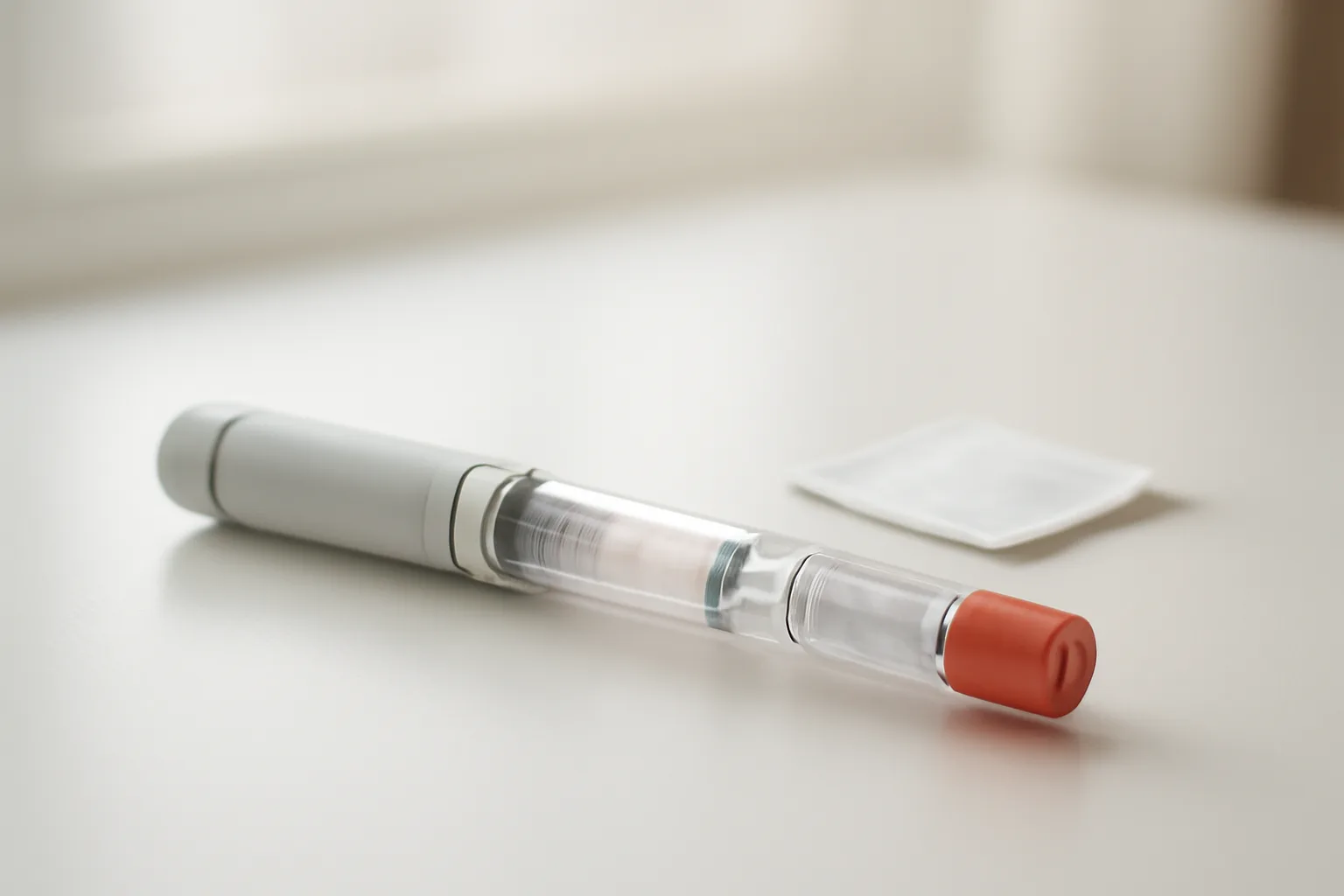
The only dose with real trial evidence behind it is 1.75 mg, delivered as a subcutaneous injection from a single-use autoinjector. That's the dose the FDA approved for Vyleesi (bremelanotide) in 2019 for hypoactive sexual desire disorder (HSDD) in premenopausal women [1]. It isn't a daily medication. You use it on an as-needed basis, roughly 45 minutes before anticipated sexual activity, and the effect is meant to last for that encounter, not build up over time [2]. The two phase 3 trials behind the approval, known as RECONNECT, tested exactly this 1.75 mg self-administered dose against placebo in premenopausal women with acquired, generalized HSDD [3]. That's the dataset any dosage chart for this drug should trace back to. Anything you see online claiming a 'bodybuilding dose' or a titration schedule up to 4 mg or more is not sourced from FDA trial data, because no such protocol was tested in the approval studies. Here's the dosage picture in one place. | Parameter | Approved value | If you're trying to reverse-engineer a dosing plan from research-grade vials rather than the approved autoinjector, that's a separate conversation with separate risks, covered below.
How is PT-141 dosage measured in units vs mL?
This is where most confusion happens, because insulin syringes are marked in 'units' (a volume convention from insulin dosing, where 100 units = 1 mL) while the actual drug dose is a mass, in milligrams. The Vyleesi autoinjector is pre-filled and pre-measured, so a patient using the approved product never has to convert anything. You press it against your skin, it delivers 1.75 mg, done. The units-vs-mL question only comes up when someone is working from a reconstituted vial of bremelanotide bought outside the approved supply chain, drawing it up with an insulin syringe. In that unregulated scenario, the math depends entirely on how the vial was reconstituted, meaning how many mg of peptide powder went into how much bacteriostatic water. A vial reconstituted differently than the person selling it assumed will throw the whole 'units' conversion off, and there's no FDA-reviewed labeling to check it against. This is the core problem with 'pt-141 dosage in units' or 'pt-141 dosage in ml' searches: the honest answer is that these units only make sense relative to a specific, verified concentration, and outside the approved product, that concentration isn't independently verified by anyone. A dosage calculator can walk through the arithmetic, but arithmetic on an unverified concentration is still an unverified dose.
What is the PT-141 injection schedule and timing?
Take it on an as-needed basis, not on a fixed calendar. The labeling studied in RECONNECT called for dosing at least 45 minutes before anticipated sexual activity, with effects expected to be relevant for a window around that timing, not as a maintenance therapy [3]. The frequency ceiling matters clinically. The approved schedule caps use at one dose per 24-hour period and no more than 8 doses per month [2]. That ceiling isn't arbitrary; it reflects the dosing frequency actually studied and the blood pressure and nausea data collected at that frequency [4]. Using it more often than that pushes you outside anything measured in trials, and the safety data doesn't extend to daily or frequent use. A practical note many people miss: because bremelanotide works on desire and arousal circuitry rather than on penile or genital blood flow directly, taking it 'just in case' every day doesn't make sense the way some people assume a PDE5 inhibitor might. It's a situational tool, used before an occasion, not a background medication.
Why is the dose fixed at 1.75 mg instead of a titration schedule?
Because that's the dose the phase 2b dose-ranging work landed on before phase 3 even started. A responder analysis from that phase 2b dose-ranging study looked across multiple dose levels and evaluated how many women responded at each, informing the choice of a single dose to carry forward [5]. The manufacturer didn't skip a titration step, they ran one earlier in development and used the results to fix the phase 3 (and eventual label) dose at 1.75 mg rather than asking prescribers to titrate. This is different from something like flibanserin (Addyi), which is a nightly oral pill. Bremelanotide's fixed, as-needed dose reflects both its mechanism (a melanocortin receptor agonist working centrally, discussed next) and its injectable route, which behaves differently in the body than a daily oral tablet [6]. A 2021 regulatory analysis in Drug and Therapeutics Bulletin compared the two approved HSDD drugs and cautioned against assuming their approval pathways or effect sizes are equivalent just because both treat the same diagnosis [7].
How does PT-141 work in the brain (and why that changes the dosage conversation)?
Bremelanotide is a melanocortin receptor agonist, acting primarily through MC4R in the central nervous system, not on blood vessels in the genitals [6]. That's the single most useful distinction to understand before looking at any dosage chart, because it explains why more of the drug doesn't simply mean 'more effect' the way people sometimes assume with vasodilators. A melanocortin system review from 2023 discusses how MC4R signaling sits inside pathways that also govern appetite and body weight regulation, which is part of why bremelanotide's early development touched on obesity research before the sexual desire indication became the approved use [8]. A separate phase 1 analysis in obese women looked specifically at bremelanotide's effect on body weight, finding measurable changes worth noting even though weight loss isn't the approved indication [9]. This overlap in mechanism is also why nausea, discussed below, is an expected on-target-ish effect rather than a random side reaction; melanocortin pathways intersect with the brain's nausea and satiety circuitry. Because the effect is centrally mediated and involves receptor systems tied to appetite, mood-adjacent circuits, and blood pressure regulation, escalating the dose past what was studied isn't just 'more of the same effect, stronger.' You're pushing further into systems that also touch nausea, blood pressure, and possibly appetite, with no phase 3 safety data to describe what happens there [4]. For readers who want the fuller mechanism explanation, see PT-141 peptide.
What are the most common PT-141 side effects at the standard dose?
Nausea and flushing are the two side effects you should expect to hear about most, and they aren't rare footnotes. Across the clinical development program, a safety profile analysis found nausea was the most frequently reported adverse event, and flushing was also common, particularly with earlier or higher doses tested before the program settled on 1.75 mg [4]. In the RECONNECT phase 3 trials specifically, nausea occurred in a meaningful minority of women on active treatment, along with flushing, headache, and injection site reactions [3]. These aren't dangerous in the acute sense for most people, but they are common enough that you should plan for them, meaning avoid taking a first dose right before something you can't step away from if you feel queasy. A less commonly discussed effect: transient blood pressure increases and a corresponding small decrease in heart rate have been observed after dosing, which is why the label advises against use in women with uncontrolled hypertension or known cardiovascular disease [4]. A 2022 review specifically addressed managing hypertension alongside female sexual dysfunction treatment, noting this blood pressure signal needs to be weighed for anyone with existing cardiovascular risk factors [10]. For the fuller rundown, see PT-141 side effects.
Does PT-141 dosage or effectiveness differ from Viagra/sildenafil?
Yes, fundamentally. This is worth separating clearly because a lot of dosage confusion online comes from treating PT-141 like a female Viagra. Sildenafil works locally and vascularly: it enhances blood flow to erectile tissue through a PDE5 inhibition mechanism, and its dose scales somewhat with that vascular effect. Bremelanotide works centrally, on melanocortin receptors tied to desire and arousal pathways in the brain, not on local blood flow [6]. An early expert review literally titled 'Bremelanotide: the female Viagra?' addressed this comparison and the ways the mechanisms diverge, even while acknowledging the nickname stuck in public conversation [11]. That mechanism difference is exactly why bremelanotide's dosage chart looks nothing like sildenafil's. There's no 25/50/100 mg range to choose from based on response, because higher-dose ranges weren't shown to add meaningful benefit over 1.75 mg in the phase 2b work that set the approved dose [5]. If you're comparing routes and want the general use-case rundown, PT-141 peptide how to use covers injection technique and administration specifics.
What happens if you take more than the recommended PT-141 dose?
Nobody has clean human safety data on doses well above 1.75 mg used repeatedly, because that's not what the approval trials tested. What we do know: earlier development work tested a range of doses, and the higher end of that range was associated with more frequent and more intense nausea and flushing, without a clear added benefit that justified carrying a higher dose into phase 3 [5]. The blood pressure effect is dose-related too. Higher doses in earlier studies produced larger transient blood pressure increases, which is a real concern for anyone with existing hypertension or cardiovascular disease, and part of why the label carries a caution against use in women with uncontrolled high blood pressure [4]. So the honest answer to 'what if I take more' is: expect worse nausea and flushing, expect a bigger blood pressure bump, and know that nobody has published data describing what a repeated higher-dose protocol does over months, because that protocol has never gone through phase 3 testing. A critical re-analysis published in the Journal of Sex Research argued that even the approved dose's benefit-to-side-effect ratio deserves scrutiny, questioning whether the measured improvement in desire scores justifies the side effect burden for the average patient [12]. That's a reasonable thing to weigh at the approved dose, let alone above it.
Is there a PT-141 dosage protocol for bodybuilding or off-label use?
Not one with FDA trial support, no. The searches for 'pt-141 dosage bodybuilding' are chasing something that doesn't have a study behind it in the way the HSDD indication does. Bremelanotide's connection to bodybuilding-adjacent interest likely traces back to its melanocortin mechanism, given MC4R's role in appetite and metabolic regulation, which some early obesity-related research explored [8] [9]. But a phase 1 body-weight finding in obese women isn't a bodybuilding protocol, and it wasn't studied at doses or frequencies aimed at physique goals. There is no published dosing chart, no phase 3 trial, and no FDA indication covering muscle gain, fat loss for athletic purposes, or performance enhancement. If your interest is genuinely metabolic rather than sexual desire related, that's a different conversation to have with a physician about approved metabolic therapies, not an unapproved use of a peptide meant for HSDD.
How do you actually administer a PT-141 injection?
The approved product is a single-use autoinjector, prefilled with 1.75 mg, injected subcutaneously into the abdomen or thigh [1]. You don't draw anything up, don't measure volume, and don't calculate units. Press the device against clean skin, activate it per the instructions that come with it, and it's done in seconds. Rotate injection sites if you're using it repeatedly across a month, the same general advice given for any subcutaneous self-injected medication, to reduce local site reactions. Injection site reactions were among the adverse events reported in the phase 3 program, though generally mild [3]. If you were prescribed it through a telehealth pathway rather than picking up an autoinjector at a retail pharmacy, ask specifically what's being dispensed and from where. A provider-reviewed prescription filled by a licensed, named pharmacy is a very different product, with very different quality assurance, than a vial bought from a peptide website with no prescription attached. Bremelanotide Rx connects readers with that provider-reviewed pathway rather than unregulated vial sales, precisely because the dosing math above only holds up when the concentration in the vial is actually known and verified.
Who should not use PT-141, regardless of dose?
The label excludes women with uncontrolled hypertension or known cardiovascular disease, because of the blood pressure and heart rate effects discussed above [4] [10]. It's also not approved for postmenopausal women or for men; the approval is specifically for premenopausal women with acquired, generalized HSDD [1]. A 2021 review in the Journal of Midwifery & Women's Health lays out the fuller diagnostic picture for HSDD, including how it's assessed and differentiated from other causes of low desire before any pharmacologic option, bremelanotide included, is considered appropriate [13]. That diagnostic step matters because bremelanotide isn't a general libido enhancer for anyone with low interest in sex, it's studied and approved for a specific, clinically diagnosed condition. Pregnancy status also matters: sexual activity isn't the goal during pregnancy planning in the same clinical sense, and prescribers will typically screen for this alongside cardiovascular history before writing a prescription.
Frequently asked questions
What is the standard PT-141 dosage in mg?
The FDA-approved dose is 1.75 mg per injection, delivered subcutaneously via a single-use autoinjector (Vyleesi). This is a fixed dose, not a range, based on the dose that carried the strongest response-to-side-effect balance in phase 2b dose-ranging work before phase 3 trials began.
How many units of PT-141 should I inject?
There's no unit conversion needed with the approved autoinjector, it delivers a pre-measured 1.75 mg automatically. 'Units' only becomes a question when someone is drawing up a reconstituted vial with an insulin syringe, and that conversion depends entirely on how that specific vial was mixed, which isn't standardized or FDA-verified.
How much PT-141 in mL is a normal dose?
The approved autoinjector's mL volume isn't something patients need to measure, it's prefilled to deliver 1.75 mg. For reconstituted research vials, the mL equivalent depends on the exact powder-to-liquid ratio used, which varies by source and isn't standardized like an FDA-approved product's labeling.
How often can you take PT-141?
The approved schedule allows one dose every 24 hours, with a monthly maximum of 8 doses. It's used as needed before anticipated sexual activity, not on a daily maintenance schedule, since the trials studied episodic dosing rather than continuous use.
How long before sex should you take PT-141?
At least 45 minutes before anticipated sexual activity, based on the timing used in the RECONNECT phase 3 trials that led to FDA approval. Taking it too close to the activity window doesn't match the studied protocol and may reduce the chance of a noticeable effect during that encounter.
Is PT-141 the same as female Viagra?
No. Sildenafil (Viagra) works locally by improving blood flow through PDE5 inhibition. PT-141 (bremelanotide) works centrally on melanocortin receptors in the brain tied to desire and arousal circuits, not on genital blood flow. The 'female Viagra' nickname is a popular shorthand, not a mechanistic description.
What are the most common PT-141 side effects?
Nausea is the most frequently reported side effect across the clinical development program, followed by flushing, headache, and injection site reactions. Transient increases in blood pressure with a corresponding decrease in heart rate have also been observed, which is why it's avoided in uncontrolled hypertension.
Can men use PT-141 and does dosage differ?
PT-141 is FDA-approved specifically for premenopausal women with hypoactive sexual desire disorder, not for men. Any use in men would be off-label and outside the dosing data generated in the approval trials, so there's no FDA-reviewed dosage chart for male use.
Is there a PT-141 dosage protocol for bodybuilding?
No. There's no FDA trial data or published protocol supporting PT-141 use for muscle gain, fat loss, or athletic performance. Interest likely stems from its melanocortin receptor mechanism, which touches appetite regulation in early research, but that isn't the same as a studied bodybuilding dose.
What happens if you take too much PT-141?
Higher doses tested in early development produced more frequent, more intense nausea and flushing, plus a bigger transient blood pressure increase, without added benefit over the 1.75 mg dose ultimately approved. There's no published safety data on repeated higher-dose use, so it isn't something to experiment with.
Does PT-141 need to be taken every day?
No. It's an as-needed medication used before anticipated sexual activity, not a daily pill or injection. The approved schedule caps use at once every 24 hours and 8 times per month, reflecting the episodic dosing pattern studied in the phase 3 trials.
How is PT-141 different from flibanserin (Addyi)?
Flibanserin is a nightly oral pill affecting serotonin and dopamine pathways, taken daily regardless of planned activity. PT-141 is an as-needed subcutaneous injection working through melanocortin receptors. A 2021 regulatory review cautioned against treating their approval pathways or effect sizes as interchangeable just because both treat HSDD.
Sources
- PubMed, Bremelanotide: First Approval (Drugs, 2019): Bremelanotide (Vyleesi) was FDA approved in 2019 as a 1.75 mg subcutaneous autoinjector for HSDD in premenopausal women
- PubMed, Bremelanotide: New Drug Approved for Treating Hypoactive Sexual Desire Disorder (Annals of Pharmacotherapy, 2020): The approved regimen is used as needed at least 45 minutes before sexual activity, with a maximum of one dose per 24 hours and 8 doses per month
- PubMed, Bremelanotide for the Treatment of Hypoactive Sexual Desire Disorder: Two Randomized Phase 3 Trials (Obstetrics and Gynecology, 2019): The RECONNECT phase 3 trials tested the 1.75 mg self-administered dose against placebo in premenopausal women with HSDD, reporting nausea, flushing, and injection site reactions
- PubMed, Safety Profile of Bremelanotide Across the Clinical Development Program (Journal of Women's Health, 2022): Nausea was the most frequently reported adverse event across the clinical development program, with dose-related blood pressure and heart rate effects also observed
- PubMed, Responder Analyses from a Phase 2b Dose-Ranging Study of Bremelanotide (Journal of Sexual Medicine, 2019): Phase 2b dose-ranging responder analysis informed selection of the fixed dose carried forward into phase 3 trials, with higher doses showing more side effects without added benefit
- PubMed, The neurobiology of bremelanotide for the treatment of hypoactive sexual desire disorder in premenopausal women (CNS Spectrums, 2022): Bremelanotide acts as a melanocortin receptor agonist working centrally on brain pathways governing desire and arousal, distinct from vascular mechanisms
- PubMed, Bremelanotide and flibanserin for low sexual desire in women: the fallacy of regulatory precedent (Drug and Therapeutics Bulletin, 2021): A regulatory analysis compared bremelanotide and flibanserin, cautioning against treating their approval pathways or effect sizes as equivalent
- PubMed, Targeting the central melanocortin system for the treatment of metabolic disorders (Nature Reviews Endocrinology, 2023): MC4R melanocortin signaling is involved in appetite and body weight regulation pathways
- PubMed, Effect of bremelanotide on body weight of obese women: Data from two phase 1 randomized controlled trials (Diabetes, Obesity & Metabolism, 2022): Phase 1 trials in obese women found measurable body weight changes with bremelanotide, distinct from the approved sexual desire indication
- PubMed, Management of Hypertension with Female Sexual Dysfunction (Medicina, 2022): Blood pressure effects of bremelanotide need to be weighed for patients with existing cardiovascular risk factors
- PubMed, Bremelanotide: the female Viagra? (Expert Review of Endocrinology & Metabolism, 2006): Early expert review addressed the 'female Viagra' comparison and how bremelanotide's mechanism diverges from sildenafil
- PubMed, Small Effects, Questionable Outcomes: Bremelanotide for Hypoactive Sexual Desire Disorder (Journal of Sex Research, 2024): A critical re-analysis questioned whether the measured improvement in desire scores at the approved dose justifies the side effect burden
- PubMed, Hypoactive Sexual Desire Disorder in Women: Physiology, Assessment, Diagnosis, and Treatment (Journal of Midwifery & Women's Health, 2021): HSDD requires specific clinical diagnosis and assessment before pharmacologic treatment is considered appropriate