Last updated 2026-07-24
TL;DR
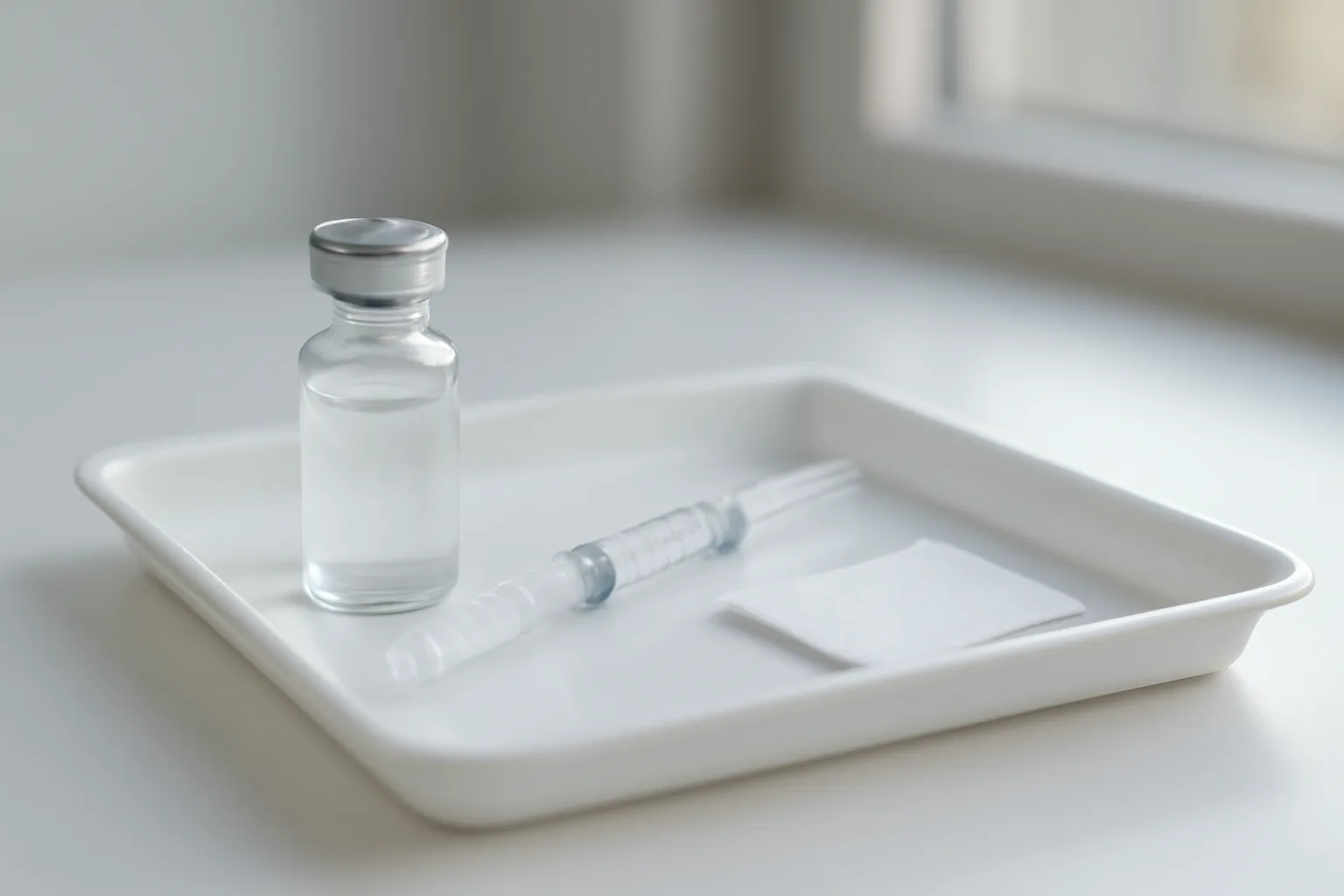
PT-141 (bremelanotide) as FDA-approved Vyleesi comes as a premixed, ready-to-use autoinjector, not a lyophilized powder you mix yourself. "Reconstitution" language mostly applies to compounded or research-grade vials, which use bacteriostatic water, sterile technique, and refrigerated storage. This article covers the general pharmacy logic behind reconstitution and why the approved product skips that step entirely [1].
What does reconstituting PT-141 actually mean?
Reconstitution just means adding a liquid to a powder to make an injectable solution. Peptides like bremelanotide are often shipped as a freeze-dried (lyophilized) powder because that form is more stable at room temperature over time. You add a diluent, usually bacteriostatic water, swirl gently, and end up with a solution you can draw into a syringe. Here's the thing worth knowing upfront: the FDA-approved version of bremelanotide, sold as Vyleesi, is not sold this way. It comes as a single-use, prefilled autoinjector with the drug already in solution at 1.75 mg per 0.3 mL [1] [2]. There is no powder, no vial, no mixing step. You open the package, pick your injection site, and use it. So when people search for reconstitution steps, they are usually asking about compounded bremelanotide or research-grade material sold in powder form, not the approved drug. That distinction matters a lot for safety and for what happens if something goes wrong.
Why doesn't the approved Vyleesi product need reconstitution?
Vyleesi was approved by the FDA in June 2019 for hypoactive sexual desire disorder (HSDD) in premenopausal women, based on two randomized phase 3 trials (the RECONNECT studies) [3]. The manufacturer built the drug as a stable, premixed solution specifically so patients could self-inject at home without a mixing step, refrigeration logistics, or a syringe-drawing routine. That single-use autoinjector format is part of the approved product design, reviewed by FDA as such [1]. It is a real practical advantage: less room for dosing error, less room for contamination, and no guesswork about diluent volume. Compounded or gray-market bremelanotide, by contrast, often does arrive as lyophilized powder because it's cheaper to ship and store that way before the patient (or a pharmacy) adds the liquid. That's a legitimate compounding practice in the right hands, but it puts more responsibility on whoever is doing the mixing.
What do you need before reconstituting a lyophilized peptide vial?
If you're working with a compounded vial (through a licensed pharmacy, under a prescription and clinical oversight), the standard supplies are: bacteriostatic water for injection, an alcohol swab, a sterile syringe with a fine needle for mixing, and the lyophilized peptide vial itself. Bacteriostatic water contains 0.9% benzyl alcohol as a preservative, which helps prevent microbial growth once the vial is opened, unlike plain sterile water. Work on a clean surface. Wash your hands. Wipe both vial stoppers with alcohol before inserting any needle. None of this is peptide-specific; it's basic aseptic technique that applies to any injectable reconstituted at home, and pharmacists teach the same steps for insulin, HCG, and other lyophilized medications. The volume of bacteriostatic water you add determines the final concentration (mg per mL), which is why accurate measurement matters more than people expect. Getting this wrong doesn't make the peptide unsafe in a dramatic way, but it does mean your actual dose is different from what you intended, which defeats the purpose of following a dosing protocol at all. For a walkthrough of dose math once you have a reconstituted solution, see our PT-141 dosage calculator and PT-141 dosage chart.
How do you reconstitute a peptide vial step by step?
This is the general sequence pharmacists and compounding guidance describe for lyophilized peptides, not brand-specific instructions: 1. Let the vial and the bacteriostatic water come to room temperature if they've been refrigerated. 2. Wipe both rubber stoppers with an alcohol swab. 3. Draw the intended volume of bacteriostatic water into a sterile syringe. 4. Insert the needle into the peptide vial at an angle, resting the needle tip against the inside wall of the vial rather than pointing it straight at the powder. 5. Push the water in slowly, letting it run down the glass wall instead of blasting the powder directly. 6. Do not shake. Swirl the vial gently, or let it sit and dissolve on its own. 7. Check that the solution is clear, with no visible particles or cloudiness, before using it. The reason for the slow, angled injection is that lyophilized powders are fragile physically. Vigorous mixing can denature (structurally damage) the peptide, which may reduce how well it works even though nothing about it looks different to the eye.
How do you know how much bacteriostatic water to add?
This depends entirely on what final concentration you're targeting, and it should be specified by whoever prescribed or compounded the vial, not guessed. As a general math example (not a recommendation): a 10 mg vial mixed with 2 mL of bacteriostatic water yields a concentration of 5 mg/mL. Mixed with 1 mL instead, the same vial yields 10 mg/mL. More diluent means a larger injection volume for the same dose, which some people find easier to measure accurately on a small insulin syringe. Less diluent means a more concentrated solution and a smaller injection volume. The approved Vyleesi dose studied in the RECONNECT phase 3 trials was 1.75 mg delivered subcutaneously as needed, at least 45 minutes before anticipated sexual activity [3]. If you're working with a compounded product, the concentration math should map back to a dose in that general range, worked out with a prescriber, not reverse-engineered from an online calculator alone.
How should reconstituted PT-141 be stored?
Once a lyophilized peptide is mixed into solution, it typically needs to be refrigerated (not frozen) and used within a defined window, often somewhere between 2 and 4 weeks depending on the specific compounding pharmacy's stability data. Before reconstitution, the dry powder is generally more stable at room temperature or under refrigeration for longer stretches. The approved Vyleesi autoinjector has its own manufacturer storage instructions on the packaging (refrigerated until dispensed, then usable at room temperature for a defined period), and patients should follow the label instructions that come with that specific product rather than generic peptide advice. Any cloudiness, discoloration, or visible particles after storage is a signal to discard the vial rather than use it. This is standard advice across injectable compounded medications, not specific to bremelanotide.
Why is bremelanotide's mechanism different from something like Viagra?
This is probably the single most misunderstood thing about PT-141, and it matters for what reconstitution and dosing actually control. Sildenafil (Viagra) works on blood vessels; it's a PDE5 inhibitor that increases blood flow to genital tissue, which is a peripheral, vascular mechanism. Bremelanotide works differently. It's a melanocortin receptor agonist, meaning it activates MC4 receptors in the central nervous system, in the brain, not in blood vessels [4] [5]. Research describes its action as acting on the neural pathways involved in sexual desire and arousal, rather than on genital blood flow directly [5]. That's why it's dosed as an as-needed injection taken ahead of anticipated activity rather than something that produces an immediate, localized physical effect the way vascular drugs do. This distinction is also why bremelanotide was studied specifically for hypoactive sexual desire disorder, a condition involving low desire, rather than for erectile or genital blood flow problems [6]. Anyone reconstituting or dosing a melanocortin peptide should understand that the drug's job is to influence brain signaling, and that has different timing and side effect implications than a vascular drug would.
What side effects should you expect after an injection?
Nausea is the most common side effect reported in the bremelanotide clinical trial program, and it's worth taking seriously rather than dismissing as minor. A pooled safety analysis across the clinical development program found nausea affecting a large share of participants, along with flushing, headache, and injection site reactions [7]. Flushing (a warm, reddened feeling in the face or chest) is also common and tends to appear within an hour or two of dosing, fading on its own. Some patients also report transient increases in blood pressure after dosing, which is part of why bremelanotide carries specific cautions for people with uncontrolled hypertension or cardiovascular disease . Nausea rates tend to be dose-related: the phase 2b dose-ranging study found that higher doses were associated with a higher proportion of participants classified as "responders" on desire measures, but also more nausea and vomiting at the higher end of the dose range tested . This is one of the real trade-offs in bremelanotide dosing, and it's a major reason the approved dose settled at 1.75 mg rather than higher. For the fuller list of what to expect and how long side effects usually last, see our guide on PT-141 peptide side effects.
Does reconstituted PT-141 actually work for low desire?
In the two RECONNECT phase 3 randomized trials, women with HSDD who received bremelanotide showed statistically significant improvements versus placebo on the Female Sexual Function Index desire domain and on a measure of desire-related distress [3]. That's the trial evidence FDA approval rests on. But the effect size is genuinely a matter of debate among researchers, and it's worth reading honestly rather than glossing over. A re-analysis published in the Journal of Sex Research argued the clinically meaningful difference between bremelanotide and placebo in the approval trials was small, and questioned whether the improvement represented a meaningful outcome for the average patient [23.1]. A separate critique in Drug and Therapeutics Bulletin raised similar concerns about regulatory precedent for HSDD drugs generally, comparing bremelanotide to flibanserin (Addyi) [8]. Subgroup analyses from the same RECONNECT data found the treatment effect held up across different baseline severity levels and demographic subgroups, which supports some consistency of effect, even if the absolute magnitude remains a point of scientific disagreement [9]. The honest summary: bremelanotide has real, FDA-reviewed trial evidence behind it, and it also has real critics who think the benefit is modest. Both things are true at once.
Is compounded or self-mixed PT-141 legal and regulated the same way as Vyleesi?
No, and this distinction matters more than most sourcing guides admit. Vyleesi is an FDA-approved drug, reviewed for safety, efficacy, and manufacturing quality under a full New Drug Application [1] [2]. Compounded bremelanotide is regulated under a different framework entirely, section 503A of the Federal Food, Drug, and Cosmetic Act, which allows licensed pharmacies to compound medications from bulk drug substances under specific conditions [102]. FDA maintains lists of bulk drug substances that can legally be used in 503A and 503B compounding [100][101]. Whether bremelanotide itself appears on these lists, and under what conditions, is something to verify directly with FDA's current bulk substances guidance rather than assume [104]. Research-grade material sold online with "not for human consumption" labeling sits entirely outside this framework and is not legally intended for human use at all, regardless of what a seller's marketing implies [103]. If you're going the compounded route, that means working with a licensed pharmacy under a prescription and clinical oversight, not buying a vial and improvising the reconstitution yourself based on forum advice. Our overview of PT-141 peptide covers the mechanism and evidence base in more depth, and our piece on PT-141 peptide for sale on Amazon covers why marketplace listings are a legal and safety problem specifically.
What if you're new to injecting PT-141? What should the first dose look like?
Whether you're using the Vyleesi autoinjector or a compounded subcutaneous injection under a prescriber's guidance, the basic technique is similar: pinch a fold of skin (typically abdomen or thigh), inject at roughly 45 to 90 degrees depending on needle length, and do it at least 45 minutes before anticipated sexual activity, matching the timing used in the RECONNECT trials [3]. Most clinical guidance recommends no more than one dose in 24 hours and no more than eight doses per month, which mirrors the dosing frequency limits studied in the approval trials. Going over that frequency has not been well studied and increases exposure to the nausea and blood pressure effects described above [7] . For first-time users, expect some nausea in the first hour or two. It's real, it's common, and it tends to lessen with repeated use in many patients, though not all. If nausea is severe or if you notice a significant blood pressure spike, that's a reason to stop and talk to the prescriber, not push through and re-dose. A full walkthrough of injection sites, timing, and technique lives at PT-141 peptide how to use.
Who should not use bremelanotide, reconstituted or otherwise?
Bremelanotide is contraindicated in patients with uncontrolled hypertension or known cardiovascular disease, largely because of the transient blood pressure increases observed after dosing in trial data . Anyone with a history of cardiovascular events should discuss this specifically with a prescriber before starting, regardless of which formulation or delivery method is being considered. It's also worth being clear about what bremelanotide is approved for: premenopausal women with acquired, generalized HSDD, not a general-purpose libido or performance product for any population [1] [2]. It has not been studied or approved for use in men, in postmenopausal women, or for conditions other than HSDD, and using research-grade peptide outside that studied population means operating entirely without the safety data that exists. People taking other medications that lower blood pressure, or who have a history of fainting or low blood pressure episodes, should flag that history explicitly, since the combined effect with bremelanotide's own transient pressure changes hasn't been mapped out in large populations.
Where does a provider-reviewed path fit into this?
Reconstitution mistakes are avoidable, but they're avoidable specifically because a pharmacist or prescriber does the concentration math, checks your blood pressure history, and hands you something already mixed correctly, or teaches you the exact steps for your specific vial. That's a meaningfully different risk profile than mixing a vial you bought online with no clinical oversight at all. Bremelanotide Rx focuses on connecting readers to that provider-reviewed path: a licensed prescriber evaluates whether bremelanotide fits your situation, and a legitimate pharmacy partner handles the actual dispensing, whether that's the FDA-approved Vyleesi autoinjector or a properly compounded, correctly labeled alternative. That's a very different starting point than an unlabeled vial and a YouTube video. If you're trying to figure out where you'd land on this decision, the honest first step is a conversation with a prescriber about your cardiovascular history and what "low desire" actually means for you clinically, not a syringe technique tutorial.
Frequently asked questions
Do you need to reconstitute PT-141 if you're prescribed Vyleesi?
No. Vyleesi, the FDA-approved form of bremelanotide, ships as a premixed, single-use autoinjector at 1.75 mg per 0.3 mL. There's no powder, no diluent, and no mixing step. Reconstitution questions almost always apply to compounded or research-grade powder vials, not the approved product [4][8].
What liquid do you use to reconstitute PT-141 powder?
Bacteriostatic water for injection is the standard diluent for lyophilized peptides generally. It contains a small amount of benzyl alcohol as a preservative, which helps limit microbial growth once the vial is punctured, unlike plain sterile water. The exact volume used should be specified by the compounding pharmacy or prescriber, not guessed.
How long does reconstituted PT-141 last once mixed?
This depends on the specific compounding pharmacy's stability testing for that formulation, but reconstituted peptides are generally refrigerated and used within a limited window, commonly cited as a few weeks. Discard any solution that looks cloudy, discolored, or has visible particles, regardless of how long it's been stored.
Can you shake the vial to help PT-141 dissolve faster?
No. Vigorous shaking can physically damage (denature) the peptide structure, which may reduce its effectiveness even though the solution still looks clear. Standard technique is to add the diluent slowly along the vial wall and then swirl gently or let it dissolve on its own.
Why does bremelanotide cause nausea?
Bremelanotide acts on melanocortin receptors in the central nervous system, and nausea is a well-documented, common effect tied to that central mechanism rather than to injection technique or reconstitution. Clinical program safety data found nausea as the most frequently reported side effect, often dose-related [5][21].
Is bremelanotide the same mechanism as Viagra or sildenafil?
No. Sildenafil is a PDE5 inhibitor that works on blood vessels to increase genital blood flow, a peripheral vascular mechanism. Bremelanotide activates melanocortin receptors (MC4R) in the brain, working centrally on desire-related neural pathways rather than on blood flow directly [7][19].
What dose of bremelanotide was used in the approval trials?
The RECONNECT phase 3 trials studied 1.75 mg administered subcutaneously as needed, at least 45 minutes before anticipated sexual activity, in premenopausal women with hypoactive sexual desire disorder [12]. That's the dose the FDA approval for Vyleesi is based on.
Is it legal to buy PT-141 powder online for self-reconstitution?
Research-grade peptide sold online, often labeled "not for human consumption," sits outside FDA's approved drug and legitimate compounding frameworks. Legal access to bremelanotide runs through a prescription, either as FDA-approved Vyleesi or through a licensed 503A/503B compounding pharmacy operating under specific bulk substance rules [100][101][102].
How many times a month can you dose bremelanotide?
Clinical guidance generally limits use to no more than one dose in 24 hours and no more than eight doses per month, mirroring the frequency studied in the RECONNECT trials [12]. Dosing more often than this hasn't been well studied for safety or added benefit.
Who should not use bremelanotide?
People with uncontrolled hypertension or known cardiovascular disease should not use bremelanotide without specific discussion with a prescriber, since it can cause transient blood pressure increases after dosing [23]. It's also only approved for premenopausal women with HSDD, not other populations or conditions.
Does bremelanotide actually work, or is the effect small?
The RECONNECT trials found statistically significant improvement over placebo on validated desire and distress measures [12]. However, independent re-analyses have argued the clinically meaningful difference is modest, and this remains a genuine point of scientific debate rather than a settled question [23.1][17].
Does reconstituted PT-141 cause weight loss?
Some phase 1 data in obese women found bremelanotide associated with changes in body weight, tied to its action on melanocortin pathways that also influence appetite and metabolism [26]. This isn't an approved or established use, and it's a separate research question from its approved HSDD indication.
Sources
- Kingsberg, Drugs (2019): Bremelanotide received its first regulatory approval as Vyleesi, reviewed for a specific formulation and delivery method.
- Journal of Midwifery & Women's Health (2021): Bremelanotide is discussed within the physiology, assessment, diagnosis, and treatment framework for hypoactive sexual desire disorder in women.
- Journal of Women's Health, Safety Profile of Bremelanotide (2022): Pooled clinical development program safety data identify nausea, flushing, headache, and injection site reactions as the most common adverse effects.
- CNS Spectrums, neurobiology of bremelanotide (2022): Bremelanotide's mechanism involves central nervous system melanocortin receptor activation related to sexual desire pathways, distinct from peripheral vascular drugs.
- Annals of Pharmacotherapy, New Drug Approved (2020): Vyleesi's approved product form and its regulatory review as a new drug for HSDD are described.
- Obstetrics and Gynecology, RECONNECT Phase 3 Trials (2019): The RECONNECT phase 3 trials studied 1.75 mg subcutaneous bremelanotide dosed at least 45 minutes before anticipated sexual activity and found significant improvement over placebo on desire and distress measures.
- Journal of Women's Health, RECONNECT subgroup analyses (2022): Prespecified subgroup analyses of the RECONNECT trials found the treatment effect held across different baseline severity levels and demographic groups.
- Drug and Therapeutics Bulletin (2021): A critical analysis compares bremelanotide and flibanserin regulatory approval and questions the strength of the precedent for HSDD drug approvals.
- Journal of Sexual Medicine, Phase 2b Dose-Ranging Responder Analyses (2019): Higher bremelanotide doses in the phase 2b dose-ranging study were associated with more responders on desire measures but also higher rates of nausea and vomiting.
- Medicina, Management of Hypertension with Female Sexual Dysfunction (2022): Bremelanotide use requires caution in patients with uncontrolled hypertension or cardiovascular disease due to transient blood pressure increases after dosing.
- Journal of Sex Research, Re-Analyzing Phase III Bremelanotide Trials (2021): A re-analysis of the phase 3 bremelanotide trials argued the clinically meaningful difference from placebo was small.
- Diabetes, Obesity & Metabolism, bremelanotide and body weight (2022): Phase 1 randomized controlled trial data in obese women examined bremelanotide's effect on body weight.
- eCFR, 21 CFR 216.23 (503A Bulks List): Federal regulation establishes the list of bulk drug substances that may be used in 503A pharmacy compounding.
- eCFR, 21 CFR 216.24 (503B Bulks List): Federal regulation establishes a separate bulk drug substances list for 503B outsourcing facility compounding.
- Cornell Law, 21 U.S.C. 353a (pharmacy compounding): Federal statute defines the conditions under which licensed pharmacies may legally compound medications under section 503A.
- eCFR, 21 CFR 201.128 (meaning of intended uses): Federal regulation defines how a product's intended use is determined, relevant to research-grade peptide labeling disclaimers.
- FDA, Bulk Drug Substances Used in Compounding Under Section 503A of the FD&C Act: FDA maintains current guidance and lists governing which bulk substances are permitted in 503A compounding.