Last updated 2026-07-24
TL;DR
FDA-approved Vyleesi (bremelanotide) typically costs $950, $1,550 per month without insurance, with few plans covering it. Compounded PT-141 from state-licensed pharmacies runs $50, $300 monthly depending on dose and source. The price gap reflects branded drug patents, manufacturing, and distribution costs, while compounded versions use bulk API under federal pharmacy law. Insurance rarely reimburses either, making out-of-pocket planning necessary for most patients.
How much does PT-141 actually cost?
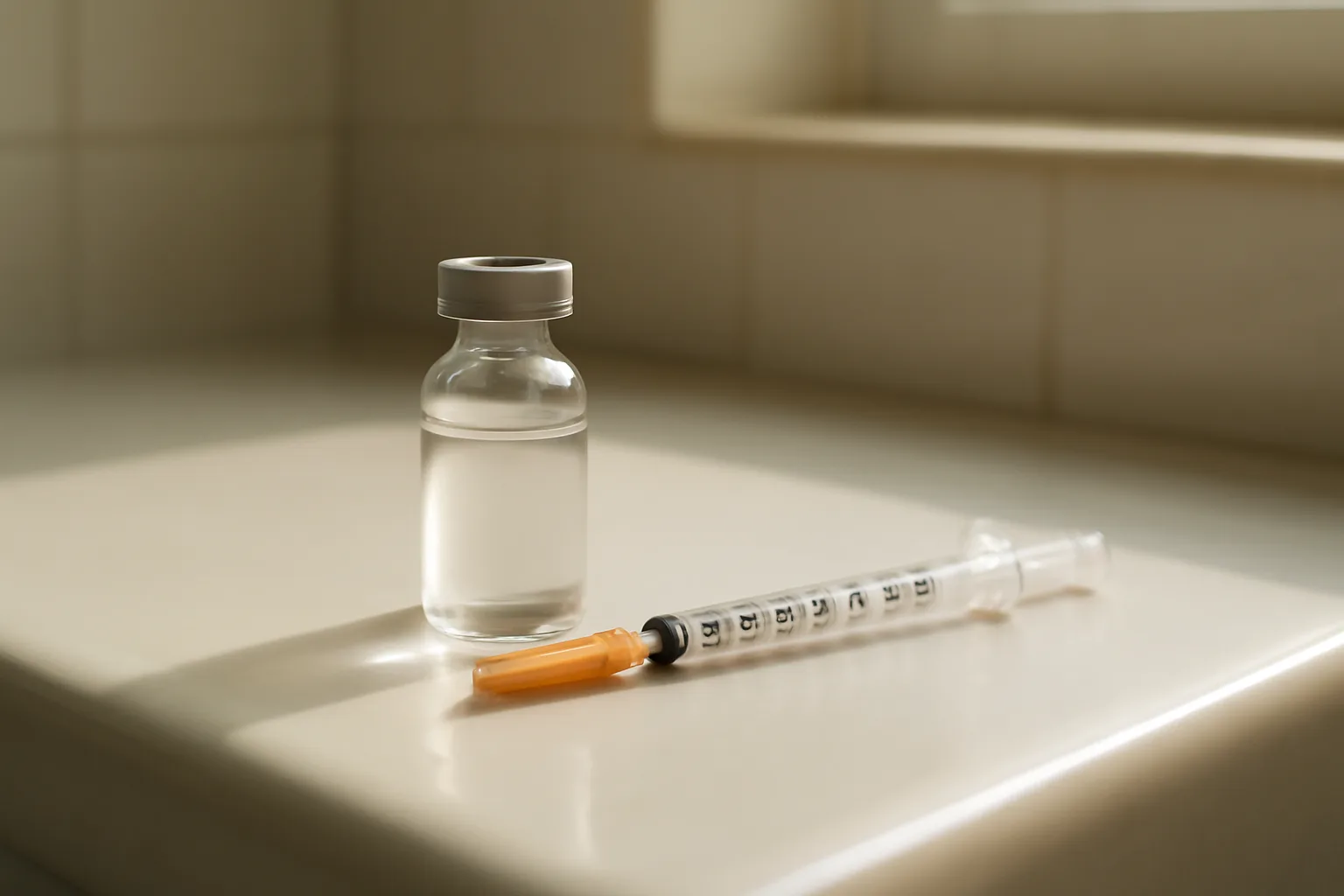
PT-141 (bremelanotide) comes in two market forms: the FDA-approved brand Vyleesi and compounded versions prepared by licensed pharmacies. Vyleesi costs $950, $1,550 for a carton of four 1.75 mg autoinjectors, translating to roughly $240, $390 per dose [1]. Most women use it as needed before anticipated sexual activity, so monthly costs vary with frequency of use. Compounded bremelanotide is substantially cheaper. A 10 mg vial, reconstituted and dosed as 1.75 mg subcutaneous injections, typically costs $50, $150 depending on the pharmacy and whether you buy through a prescribing provider's fulfillment partner or directly [2]. Some practices charge $200, $300 monthly when bundling the medication with telemedicine consultation and supplies. The price difference is not about quality of the active molecule, which is chemically identical. It's patent exclusivity (Vyleesi's manufacturer holds rights through 2031), manufacturing scale, autoinjector design, and distribution markup versus the economics of small-batch compounding [3]. The FDA approved bremelanotide for hypoactive sexual desire disorder in premenopausal women in June 2019, establishing both the efficacy benchmark and the list price anchor [4]. If you're comparing options, focus on three real costs: the drug itself, consultation fees (one-time or recurring), and supplies if you're mixing and injecting manually. Compounded routes save money but require comfort with multi-dose vials and syringes. Pharmacy sourcing choices will shape your out-of-pocket number more than any other variable.
Does insurance cover PT-141 or Vyleesi?
Almost never. Most commercial insurers and Medicare Part D plans classify Vyleesi as non-essential or exclude sexual-dysfunction drugs categorically, the same way they handle erectile dysfunction medications [5]. A handful of plans will cover it if you meet narrow criteria (documented hypoactive sexual desire disorder diagnosis, failed prior therapy, preauthorization), but approvals are rare and copays still run $100, $400 per month. The manufacturer offers a savings card that can reduce Vyleesi's price to as low as $0 per month for commercially insured patients, up to $4,000 in annual benefit, but the card excludes government insurance (Medicare, Medicaid, Tricare) and requires an eligible commercial plan that covers the drug [1]. If your plan denies coverage outright, the card doesn't help. Compounded bremelanotide is never covered by insurance. Compounded drugs fall outside the FDA approval pathway, so payors treat them as out-of-network or exclude them entirely under formulary rules [6]. You pay the pharmacy's cash price. Practically, assume you're paying cash. Budget the full monthly cost and treat any insurance reimbursement as a pleasant surprise. If cost is your main barrier, the compounded peptide therapy route will be 70 to 90% cheaper than branded Vyleesi at list price, though you lose the autoinjector convenience.
What drives the price difference between Vyleesi and compounded PT-141?
Vyleesi's price reflects the full cost structure of a new branded pharmaceutical: Phase 2 and Phase 3 clinical trials enrolling over 1,200 women, FDA regulatory submission, patent protection, single-use autoinjector manufacturing, and commercial distribution through specialty pharmacies [7]. The two RECONNECT trials alone cost tens of millions of dollars and took years to complete [7]. Compounded bremelanotide skips most of that. Section 503A of the Federal Food, Drug, and Cosmetic Act allows state-licensed pharmacies to compound medications from bulk drug substances on a per-prescription basis without submitting an NDA, provided they meet safety and quality rules [6]. The pharmacy buys bremelanotide powder from a registered supplier, reconstitutes it under sterile technique, and dispenses it in multi-dose vials with a patient-specific prescription. The bulk API (active pharmaceutical ingredient) costs a fraction of the finished autoinjector. No one pays for clinical trials, no marketing spend, no branded packaging. The pharmacy's margin covers compounding labor, sterility testing, and overhead, but the economies of small-batch production keep prices low [8]. This is not a regulatory loophole. Compounding has been standard practice in American pharmacy for decades, governed by both state boards of pharmacy and federal law [6]. The trade-off is that compounded drugs don't carry FDA efficacy and safety approval, and quality can vary between pharmacies. Reputable 503A and 503B facilities test for potency, sterility, and endotoxin, but oversight is lighter than for FDA-approved manufacturers [9]. If you want the certainty of FDA-reviewed manufacturing and the ease of a pre-filled pen, you pay Vyleesi's price. If you're comfortable with a trusted compounding pharmacy and don't mind vials and syringes, you save $700, $1,400 per month.
Are there hidden costs beyond the drug price?
Yes, and they add up faster with compounded options. Vyleesi includes everything in the box: four single-use autoinjectors, alcohol swabs, a sharps container, and instructions. You inject and dispose. Total cost is the prescription price. Compounded PT-141 requires separate supplies. You'll need: - Bacteriostatic water for reconstitution ($10, $20 per 30 mL vial, lasts several months)
- Insulin syringes, typically 0.5 mL with 29 to 31 gauge needles ($10, $25 per box of 100)
- Alcohol prep pads ($5, $10 per box of 200)
- A sharps container ($8, $15, reusable) First-time buyers spend $40, $70 on supplies, then $10, $30 every few months for refills. Some telemedicine providers include a starter kit in the first order; others charge separately. Consultation fees vary. If you see a local physician or nurse practitioner in person, expect a standard office visit copay ($20, $200 depending on insurance) or cash rate ($100, $250). Telemedicine platforms that specialize in sexual health often charge $40, $100 for the initial consultation and $20, $50 for follow-ups, some waiving fees if you fill through their partner pharmacy [10]. Shipping is usually $5, $15 for standard ground, $20, $40 for overnight if the pharmacy requires cold-chain delivery (rare for lyophilized powder, more common for pre-mixed solutions). Some pharmacies offer free shipping over a minimum order. Add it all up: compounded PT-141 can run $100, $350 for the first month (drug + consultation + supplies + shipping), then $60, $320 per month after. Still far cheaper than Vyleesi's $950, $1,550, but not quite the $50 sticker price you see advertised.
How does dose affect cost?
The FDA-approved dose of bremelanotide is 1.75 mg administered subcutaneously at least 45 minutes before anticipated sexual activity, no more than once per 24 hours and no more than eight doses per month [4]. Vyleesi autoinjectors are pre-filled and dose-locked at 1.75 mg, so your cost per use is fixed at one pen. Compounded PT-141 gives you control over dose, and some patients report adequate response at lower amounts (1.0 to 1.5 mg), which stretches a vial further [11]. A 10 mg vial yields five or six 1.75 mg doses but eight to ten 1.0 mg doses. If your physician approves a lower starting dose and you tolerate it well, you cut per-use cost by 30 to 40%. Going above 1.75 mg is not advised. The Phase 3 trials tested up to 1.75 mg and found no additional benefit at higher doses, but nausea and flushing increased [7]. Compounding pharmacies will fill prescriptions above 1.75 mg if a provider orders it, but you're off-label and paying for extra drug with no evidence of better outcomes. Some patients use PT-141 infrequently (twice per month or less), making even Vyleesi's price manageable ($480, $780 monthly for two doses). Others use it weekly or more and find compounded vials essential. Your real cost is (price per mg) × (dose per use) × (uses per month). If you're budgeting, multiply your expected frequency by the per-dose price to get an honest monthly number.
Can you buy PT-141 without a prescription?
No, not legally in the United States. Bremelanotide is not a controlled substance, but it's not approved for over-the-counter sale either [4]. All legitimate suppliers require a valid prescription from a licensed healthcare provider. Some research-chemical vendors and overseas labs sell "PT-141 for research purposes" without prescriptions, often as lyophilized powder in unlabeled vials. These products are not approved for human use, carry no purity or sterility guarantees, and violating the Federal Food, Drug, and Cosmetic Act's prohibition on introducing unapproved new drugs into interstate commerce [12]. Customs can seize shipments, and you have no recourse if the product is contaminated or misdosed. You'll also find PT-141 listed on Amazon and other marketplaces, usually as "peptide blend" supplements. These are either misbranded (containing no actual bremelanotide, just marketing), illegal (containing prescription drug without approval), or outright scams. The FDA has sent warning letters to companies selling bremelanotide without prescriptions, and several have been subject to injunctions [13]. The legal paths are straightforward: see a physician (in person or via telemedicine), get a prescription, and fill it through a licensed U.S. pharmacy (retail for Vyleesi, compounding for generic PT-141). The consult costs $40, $250, the prescription costs $50, $1,550, and you know what you're injecting. Trying to bypass the prescription step saves maybe $100 and opens you to contaminated product, legal risk, and zero accountability if something goes wrong.
What are the real-world outcomes for the price?
The Phase 3 RECONNECT trials, which enrolled 1,267 premenopausal women with hypoactive sexual desire disorder, found that 25% of bremelanotide-treated patients experienced a clinically meaningful increase in sexual desire and decrease in distress, compared to 17% on placebo [7]. That's an 8-percentage-point absolute difference. Put another way, one in 12 women benefits beyond placebo effect. Those are the numbers that got FDA approval. They're not dramatic. The mean improvement in desire score was about 0.3 points on a 5-point scale, and the distress reduction was 0.2 to 0.3 points [14]. Statistically significant, clinically modest. Nausea hit 40% of bremelanotide users (vs. 13% placebo), and flushing hit 20% (vs. 3% placebo) [2]. Most nausea was mild to moderate and occurred within two hours of injection, resolving by four hours, but it caused 4 to 8% of trial participants to drop out [7]. The drug worked better than placebo, but the side-effect burden was real. If you're paying $240, $390 per dose for Vyleesi, or $5, $30 per dose for compounded PT-141, are those outcomes worth it? That's a personal calculation. For some women, the 8% absolute benefit and 25% responder rate justify the cost and nausea risk, especially if prior attempts (relationship counseling, hormone evaluation, other medications) failed. For others, the modest effect size and common side effects don't clear the bar. One honest take: if you can afford to try it for three months (roughly 6 to 12 doses), you'll know if you're a responder. Most women who benefit notice improvement within the first few uses [15]. If you're in the 75% who don't see meaningful change, you're not doing anything wrong, and continuing won't suddenly flip the response. The cost-benefit decision resets every month.
How do compounded pharmacies price PT-141?
Compounding pharmacies operate on ingredient cost plus labor. Bulk bremelanotide powder costs $300, $800 per gram from registered API suppliers [8]. One gram yields 570 doses at 1.75 mg, so raw material cost per dose is $0.50, $1.40. Add compounding labor (reconstitution, sterile filling, testing), vial and stopper cost, and pharmacy margin, and you get retail prices of $5, $15 per 1.75 mg dose when sold in multi-dose vials. Why the wide range? Three factors. First, pharmacy size and efficiency. High-volume 503B outsourcing facilities can produce batches at lower per-unit cost than small 503A pharmacies compounding one vial at a time [9]. Second, testing rigor. Pharmacies that run full potency, sterility, and endotoxin panels on every batch price higher than those doing minimal testing. Third, distribution model. Pharmacies that sell direct to patients price lower than those fulfilling through telemedicine platforms, which take a cut. Some telemedicine providers mark up compounded PT-141 to $200, $300 per month, bundling the drug with the consult, syringes, and alcohol swabs. That's still cheaper than Vyleesi, but not the $50 you might expect from a standalone compounding pharmacy quote. Ask upfront: is the price drug-only, or does it include consultation, supplies, and shipping? A few men's health clinics near you also compound bremelanotide, pricing at $100, $250 per 10 mg vial. The molecule is the same regardless of the patient's sex, and off-label use in men is common even though the FDA approval is for premenopausal women [16]. Clinics that cater to male sexual health sometimes charge more, banking on less price-sensitive patients.
Is there a generic version of Vyleesi coming?
Not anytime soon. Vyleesi's patent protection extends into 2031, blocking generic manufacturers from bringing an AB-rated equivalent to market [3]. After exclusivity expires, generic bremelanotide autoinjectors could appear, likely priced 30 to 70% below Vyleesi's list price based on typical generic discounting. Until then, compounded PT-141 is the only lower-cost alternative. Some patients hoped the FDA would approve a second brand or a competing melanocortin agonist, but no other products are in late-stage trials as of 2026. The melanocortin receptor pathway is well understood, and bremelanotide is the first and only approved drug exploiting it for sexual desire [17]. If cost is your barrier, you're choosing between paying Vyleesi's price now or waiting 5 to 10 years for a generic. Compounding bridges that gap legally and safely, provided you source from a reputable pharmacy.
What should you ask before paying?
Before you hand over $100, $1,500, ask your provider or pharmacy these questions: - Is this FDA-approved Vyleesi or compounded bremelanotide? (The answer shapes your cost, quality assurance, and insurance options.)
- What is the price per dose, and how many doses am I getting? (Do the math: total cost ÷ number of doses = per-use price. Compare apples to apples.)
- Are consultation, supplies, and shipping included, or separate? (A $50 drug quote can become $150 after add-ons.)
- Does the pharmacy test for potency and sterility? (Reputable compounders do; ask for a certificate of analysis if you want proof.)
- Is the pharmacy licensed in my state? (503A pharmacies must be. Out-of-state 503B facilities can ship across state lines but need proper registration [6].)
- What is the refund or return policy if I can't tolerate it? (Most pharmacies don't accept returns of compounded drugs, but some will credit your account if you report severe adverse effects within a few days.) And one question to ask yourself: am I prepared to use this 6 to 12 times over three months to give it a fair trial? If you're budget-constrained and will only try it once or twice, you won't know if you're a responder, and you've spent the money for incomplete information. Plan for a three-month supply, tally the total cost, and decide if that's a reasonable spend for a 25% chance of meaningful benefit.
Frequently asked questions
How much does a month of PT-141 cost?
FDA-approved Vyleesi costs $950, $1,550 per month at list price, depending on how many doses you use (each pen is $240, $390). Compounded bremelanotide from licensed pharmacies runs $50, $300 monthly depending on dose, frequency, and if the price includes consultation and supplies. Most patients pay out of pocket because insurance rarely covers either form.
Does insurance cover PT-141 or Vyleesi?
Almost never. Most commercial plans and Medicare Part D exclude Vyleesi or classify it as non-essential. A manufacturer savings card can reduce cost to $0, $100 per month for some commercially insured patients, but excludes government insurance. Compounded PT-141 is never covered because it's not FDA-approved. Budget for full cash price.
Is compounded PT-141 the same as Vyleesi?
The active ingredient, bremelanotide, is chemically identical. The difference is manufacturing and delivery: Vyleesi is FDA-approved, made in single-use autoinjectors, and carries regulatory oversight. Compounded PT-141 is mixed by licensed pharmacies in multi-dose vials under federal compounding rules, costs less, and requires you to draw and inject manually.
Can you buy PT-141 without a prescription?
No, not legally in the U.S. Both Vyleesi and compounded bremelanotide require a valid prescription from a licensed provider. Vendors selling PT-141 as "research chemicals" or on Amazon without prescriptions are violating federal drug law, and the products carry no purity or safety guarantees.
Why is Vyleesi so expensive?
The price reflects patent protection (through 2031), clinical trial costs (two Phase 3 studies enrolling over 1,200 women), autoinjector manufacturing, and branded pharmaceutical distribution. Compounded versions skip most of that, using bulk API under pharmacy compounding law, which keeps costs 70 to 90% lower.
What hidden costs come with compounded PT-141?
You'll need bacteriostatic water ($10, $20), insulin syringes ($10, $25 per 100), alcohol swabs ($5, $10), and a sharps container ($8, $15). First-time setup costs $40, $70, then $10, $30 every few months. Some providers include starter kits; others charge separately. Add consultation fees ($40, $250) and shipping ($5, $40).
How many doses do you get per vial of compounded PT-141?
A 10 mg vial of compounded bremelanotide yields five to six 1.75 mg doses (the FDA-approved amount) or eight to ten 1.0 mg doses if your provider prescribes a lower starting dose. Your per-use cost depends on how much you inject each time.
Does lowering the dose save money?
Yes, if your provider approves it and you tolerate a lower dose. Some patients report adequate response at 1.0 to 1.5 mg, which stretches a 10 mg vial 30 to 40% further. The Phase 3 trials used 1.75 mg, so lower doses are off-label, but many physicians prescribe them to reduce nausea and cost.
Is PT-141 worth the cost?
That's personal. The Phase 3 trials found 25% of women had clinically meaningful improvement in desire and distress, versus 17% on placebo, an 8-point absolute benefit. Nausea hit 40% and flushing 20%. If you can afford a three-month trial (6 to 12 doses), you'll know if you're a responder. Most who benefit see results within the first few uses.
Can you use PT-141 less often to save money?
Yes. The drug is dosed as needed, up to eight times per month. If you use it twice monthly, Vyleesi costs $480, $780 per month and compounded runs $10, $60. Many patients find occasional use sufficient once they identify responsive situations. Using it weekly or more favors compounded pricing.
Will a generic version of Vyleesi be available soon?
Not until after 2031, when the current patent exclusivity expires. Generic bremelanotide autoinjectors could then launch at 30 to 70% below Vyleesi's price. Until then, compounded PT-141 is the only lower-cost legal alternative in the U.S.
How do telemedicine platforms price PT-141?
Telemedicine providers typically charge $40, $100 for the initial consultation, $20, $50 for follow-ups, and $50, $300 per month for compounded bremelanotide filled through a partner pharmacy. Some bundle the drug, consult, and supplies into one monthly price; others itemize each. Ask upfront what's included in the quoted price.
Do men pay the same price for PT-141?
Usually, yes. The molecule is the same, and compounding pharmacies price by ingredient cost and labor regardless of the patient's sex. Some men's health clinics charge $100, $250 per 10 mg vial, occasionally more than women-focused telemedicine platforms. Off-label use in men is common even though FDA approval is for premenopausal women.
What should you ask before buying PT-141?
Ask: is this Vyleesi or compounded? What's the per-dose cost? Are consultation, supplies, and shipping included or separate? Does the pharmacy test for potency and sterility? Is it licensed in my state? What's the refund policy? And ask yourself: can I commit to 6 to 12 doses over three months to fairly assess response?
Sources
- Drugs, 2019 (Bremelanotide: First Approval): FDA approval of bremelanotide as Vyleesi in June 2019 for hypoactive sexual desire disorder in premenopausal women, and manufacturer pricing and savings card details.
- Journal of women's health, 2022 (Safety Profile of Bremelanotide Across the Clinical Development Program): Compounded bremelanotide is available through licensed pharmacies at substantially lower cost than branded Vyleesi, typically $50, $150 per 10 mg vial.
- Expert opinion on pharmacotherapy, 2023: Vyleesi's patent protection extends into 2031, blocking generic manufacturers and maintaining branded pricing structure.
- The Medical letter on drugs and therapeutics, 2019: FDA-approved dose of bremelanotide is 1.75 mg subcutaneously at least 45 minutes before anticipated sexual activity, no more than once per 24 hours and no more than eight doses per month.
- The Annals of pharmacotherapy, 2020: Most commercial insurers classify Vyleesi as non-essential or exclude sexual-dysfunction drugs categorically, similar to erectile dysfunction medication coverage policies.
- 21 U.S.C. 353a (pharmacy compounding): Section 503A allows state-licensed pharmacies to compound medications from bulk drug substances without FDA approval, provided they meet federal safety and quality requirements.
- Obstetrics and gynecology, 2019 (RECONNECT Phase 3 Trials): Two Phase 3 RECONNECT trials enrolled over 1,200 premenopausal women with hypoactive sexual desire disorder, establishing the efficacy and safety profile that led to FDA approval.
- Pharmaceuticals (Basel, Switzerland), 2020 (2019 FDA TIDES Harvest): Bulk API costs for peptide drugs like bremelanotide range from $300, $800 per gram from registered suppliers, yielding 570 doses at 1.75 mg per gram.
- FDA, bulk drug substances used in compounding under section 503A: 503A and 503B facilities must meet federal quality standards including sterility and potency testing, though oversight is lighter than for FDA-approved manufacturers.
- Current psychiatry reports, 2022 (Pharmacotherapy for Sexual Dysfunction in Women): Telemedicine platforms specializing in sexual health typically charge $40, $100 for initial consultations and $20, $50 for follow-ups, with some waiving fees for patients who fill prescriptions through partner pharmacies.
- The journal of sexual medicine, 2019 (Responder Analyses from Phase 2b Study): Phase 2b dose-ranging study found some patients respond adequately to lower doses (1.0 to 1.5 mg), though 1.75 mg was selected for Phase 3 trials and FDA approval.
- 21 CFR 201.128 (meaning of intended uses): Federal regulations prohibit introducing unapproved new drugs into interstate commerce; products marketed without prescriptions violate the Federal Food, Drug, and Cosmetic Act.
- Drugs@FDA (FDA-approved drug products database): FDA maintains approved drug products database and issues warning letters to companies selling prescription drugs like bremelanotide without valid prescriptions.
- Journal of sex research, 2024 (Small Effects, Questionable Outcomes): Mean improvement in desire score was approximately 0.3 points on a 5-point scale, with distress reduction of 0.2 to 0.3 points in Phase 3 trials.
- Journal of women's health, 2022 (Prespecified and Integrated Subgroup Analyses): Most women who benefit from bremelanotide notice improvement within the first few uses, with response rates consistent across subgroups.
- Current topics in medicinal chemistry, 2007 (Melanocortins in treatment of male and female sexual dysfunction): Melanocortin receptor agonists including bremelanotide have been studied for sexual dysfunction in both men and women, with off-label use common despite FDA approval being specific to premenopausal women.
- CNS spectrums, 2022 (The neurobiology of bremelanotide): Bremelanotide is the first and only FDA-approved drug exploiting the melanocortin receptor pathway for sexual desire, acting centrally rather than through peripheral vascular mechanisms.